

Health and Safety

The 3 Point Contact Ladder Rule: What It Is and How to Follow It
Posted on June 16, 2026
Falls from height are the leading cause of fatal workplace injuries in Great Britain. According to the HSE fatal injuries report for 2024/25, 35 workers died as a result of falls from height in a single year, accounting for over a quarter of all worker fatalities. Many of those incidents involved ladders. The 3 point contact ladder rule is one of the most practical ways to reduce that risk and should be a top priority on every climb. This guide explains what the rule means, how climbing ladders correctly reduces the risk of falls on different ladder types, and what to do when you genuinely need both hands free at the working position.
Read More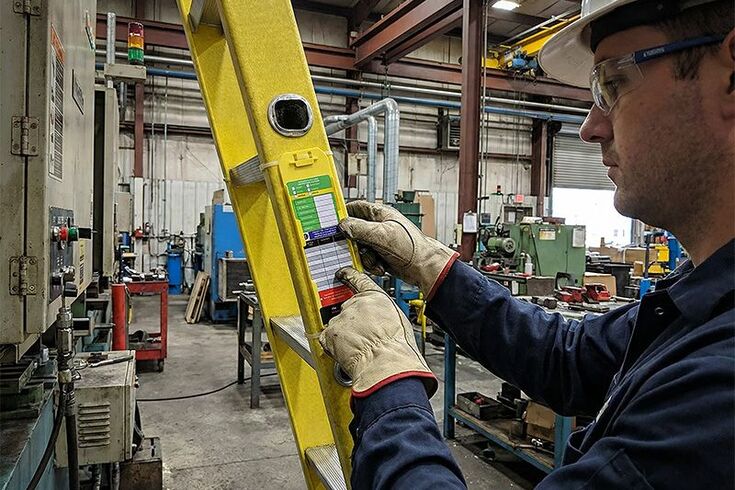
Ladder Inspection Checklist: What UK Employers Must Document to Stay Compliant
Posted on June 12, 2026
Falls from height remain the leading cause of fatal workplace injuries in Great Britain. When something goes wrong, one of the first questions the HSE asks is not "did you buy a good ladder?" It's "where are your inspection records?" That's the part most ladder inspection guides miss. They tell you what to look at. This one covers both: a complete, free ladder inspection checklist you can use immediately, and the documentation framework that proves compliance under the Work at Height Regulations 2005. Because an inspection that wasn't recorded is, legally speaking, an inspection that never happened.
Read More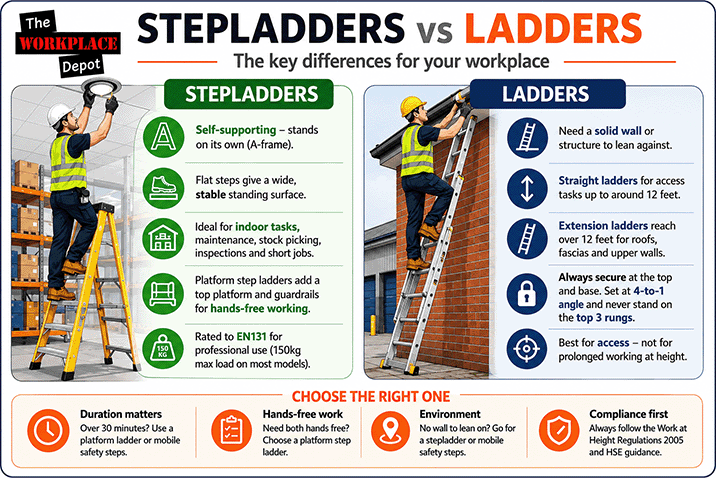
Stepladder vs Ladder: How to Choose The Right One For Your Workplace
Posted on June 12, 2026
Falls from height remain the leading cause of fatal workplace injuries in Great Britain. According to the HSE fatal injuries report for 2024/25, 35 workers were killed as a result of falls from height in a single year, and the right ladders may have prevented these incidents. This guide is written for facilities managers, warehouse teams, and health and safety officers who need a straight answer: when do you reach for a stepladder, and when do you need a leaning ladder? You'll get a clear comparison of both types, a practical selection checklist, and the one factor most guides never mention, which often turns out to be the most important of all.
Read More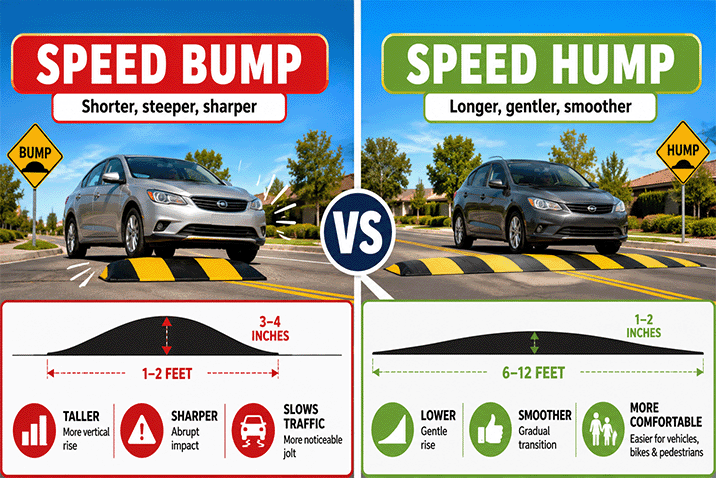
Speed Bump vs Speed Hump: What's the Difference and Which Do You Need?
Posted on June 11, 2026
"Speed bump" and "speed hump" aren't the same thing. Fitting the wrong one to your site can mean poor speed reduction, vehicle damage complaints, or a device that's not legally permitted in that location. Here's what you need to know before specifying either.
Read More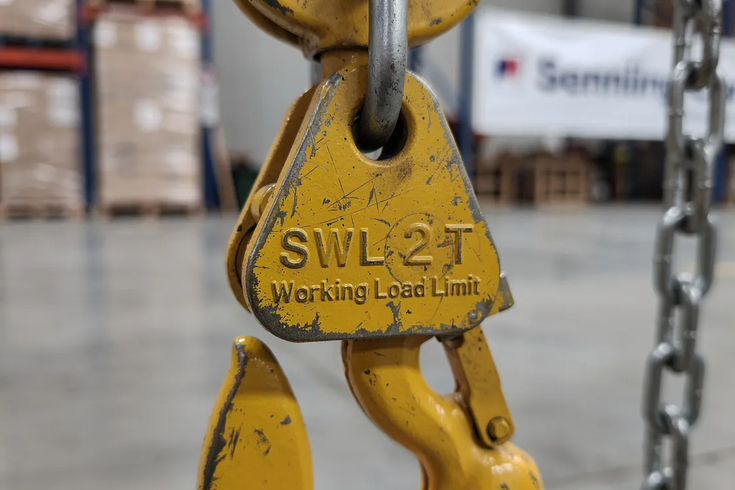
Safe Working Load (SWL): What It Means, How It's Calculated, and Why the Number on Your Equipment Is Only Half the Story
Posted on June 10, 2026
Most people checking the safe working load on a piece of lifting equipment are looking for one number. But that number was calculated for specific conditions: a straight pull, normal temperature, no shock loading, ideal configuration. Change any of those conditions and you've changed the effective SWL, whether the label has been updated or not.
Read MoreHealth and Safety in Catering and Hospitality: A Practical Guide for UK Businesses
Posted on June 03, 2026
The hospitality industry employs around 3.5 million people in the UK and contributes an estimated £93 billion to the economy every year. The Health and Safety Executive recorded 124 work-related fatalities across Great Britain in 2024/25. For a sector defined by wet floors, heavy lifting, high-temperature equipment, and hazardous cleaning chemicals, that context matters. What's less obvious is that the vast majority of workplace injuries are preventable. Essential Health and Safety Equipment for Catering and Hospitality Before diving into the detail, here's a quick reference to the key equipment most catering and hospitality businesses need in place. We'll cover the why throughout the guide below. Hazardous storage cabinets for COSHH-compliant chemical storage, separate from food areas Hygienic kitchen shelving for food-safe storage at the correct working height Catering trolleys to reduce manual carrying of heavy loads between areas First aid kits to meet your legal first aid provision...
Read MoreLabelling Hazardous Storage – GHS
Posted on February 04, 2015
The Globally Harmonised System of Classification and Labelling of Chemicals, also known as GHS, is an internationally recognised system that conforms to consistent criteria regarding the classification and labelling of chemicals. Chemical classification is extremely important; it helps you to be aware of how the chemicals you are supplying could potentially harm you, others around you and the environment. If you are unsure about the legislation regarding the labelling requirements of chemicals you may be handling and supplying, visit the HSE website for more information. Understanding GHS The GHS was created by the United Nations, after development began at the United Nations Rio Conference in 1992. Considering the fact that there used to be a variety of regulations concerning hazard classification being carried out in numerous countries, although these were similar in content, they resulted in multiple meanings for the same hazard in different countries. With this in mind, it was decided...
Read MoreBarrier Man – The Superhero We've All Been Waiting for…
Posted on August 04, 2014
Not quite Superman, Spider-man or Batman, but a recent Facebook post from popular publishing page ‘The Lad Bible’, has given the world an everyday superhero that may actually be a bit more of a realistic aspiration for 5 year olds! ‘Barrier Man’ gained almost 100,000 likes, over 3,800 shares and 2,500 comments on Facebook when a picture of a worker was posted with the caption ‘The Superhero we’ve all been waiting for’. Of course we shouldn’t take away from the seriousness of Barrier Man’s job and the fact that guys like him are actually providing a service to the public – much like the superhero’s we read about in comics! (Although potentially less life risking). Look closely at the picture below and you can tell that there is work being carried out next to a particularly busy area, possibly in front of a University or office block, and that the man is ensuring the barrier is correctly in place to protect pedestrians from a potentially dangerous work area, as a well as a busy road. Let’s...
Read MoreAre You Sitting Comfortably? – The Importance of Office Chairs
Posted on July 10, 2014
The importance of office chairs may sometimes go unnoticed, however not only can a comfortable chair increase concentration, it is also good for your health... There are not many worse things I can think of than going to work, sitting down on the most uncomfortable chair and knowing you will be there for the next 8 hours! Although it may seem trivial, sitting comfortably at work would surely put you in a better mood and even make you feel more productive. A report from the Continuing Education Unit has found that slouching and similar seated postures can cause backaches, headaches, fatigue and poor concentration, however a healthy posture promotes greater overall comfort and improved awareness. If, like many of us, you are faced with the everyday mundane office chair, why not try one of the following ways to spice it up a bit: Add new wheels – a smoother glide across the room and added colour can make your chair more exciting. Footrest – it can be difficult to decide how to rest your...
Read MoreWorkplace First Aid Kit - What Should It Contain?
Posted on May 29, 2014
As an employer it is your responsibility to maintain the safety of all employees within the workplace. Ensuing you provide a first aid box which meets British Standards is essential, however the decision on what your first aid box contains depends entirely on what you assess your needs to be. As a guide where the working environment is ranked as low risk (e.g. an office), HSE recommend a minimum stock should be: - a general guidance leaflet - 20 sterile plasters (of assorted sizes) - two sterile eye pads - four sterile triangular bandages - six safety pins - two large sterile wound dressings - six medium-sized sterile wound dressings - three pairs of disposable gloves It is highly recommended that you DO NOT keep medicines and tablets within a workplace first aid kit. The Health and Safety Executive (HSE) only provide this as a minimum recommendation, employers may wish to refer to British Standard 8599 which provides more information on the contents of first aid kits within the workplace...
Read MoreThe Need for Cable Protectors at Events
Posted on May 27, 2014
No matter what the event; indoors or outdoors, big or small, village fete or music festival, regardless of the nature and purpose of the event all loose leads and cables pose their own risk to property and life. Carrying out advanced planning and risk assessing, ensuring cable protection is thoroughly thought threw is vital. If you are thinking about setting up your own event, you need to make sure that you understand that you as the organiser are legally accountable for any accidents that may occur during the event, so having cable protectors in place is essential. Events can be so hazardous that the Health and Safety Executive (HSE) has dedicated a section of their website to cover the topic, click here to read more. Cable protectors are mostly rubber or plastic material cases, enabling you to keep your cables safe and secure, preventing trip hazards to users and damage to the property using the cable. Also used outside, these protectors can cover leads and allow users to drive...
Read MoreOffice First Aid - What First-Aiders and Employers Ought to Know
Posted on May 22, 2014
Lisa Driver, the 47-year-old mother of two has no recollections of the fall that made her an epileptic. Her friend Elaine Bristow remembers they were not drunk, although Mrs. Driver had consumed five Vodka and Cokes. When they were waiting for a taxi, Lisa went into the private car park of the Roman Painted House in Dover, looking for "somewhere to wee". She tripped and fell over a 2-feet high wall and fractured her skull. She later sued the Roman Painted House for £1 million, claiming that the site was dangerous. It was only last week, after almost 6 years of the accident that her claim was rejected and the Roman Painted House was absolved of the liability. The incident underlines the importance of maintaining safety in and around the workplace, regardless of how benign your line of work may be. Making first-aid arrangements is an essential part of health and safety around the workplace. First Aid at Work - Everyone's Responsibility, but the Axe Usually Falls on the Employer All employers...
Read More