

"Speed bump" and "speed hump" aren't the same thing. Fitting the wrong one to your site can mean poor speed reduction, vehicle damage complaints, or a device that's not legally permitted in that location. Here's what you need to know before specifying either.
Speed Bump vs Speed Hump: What's the Difference?
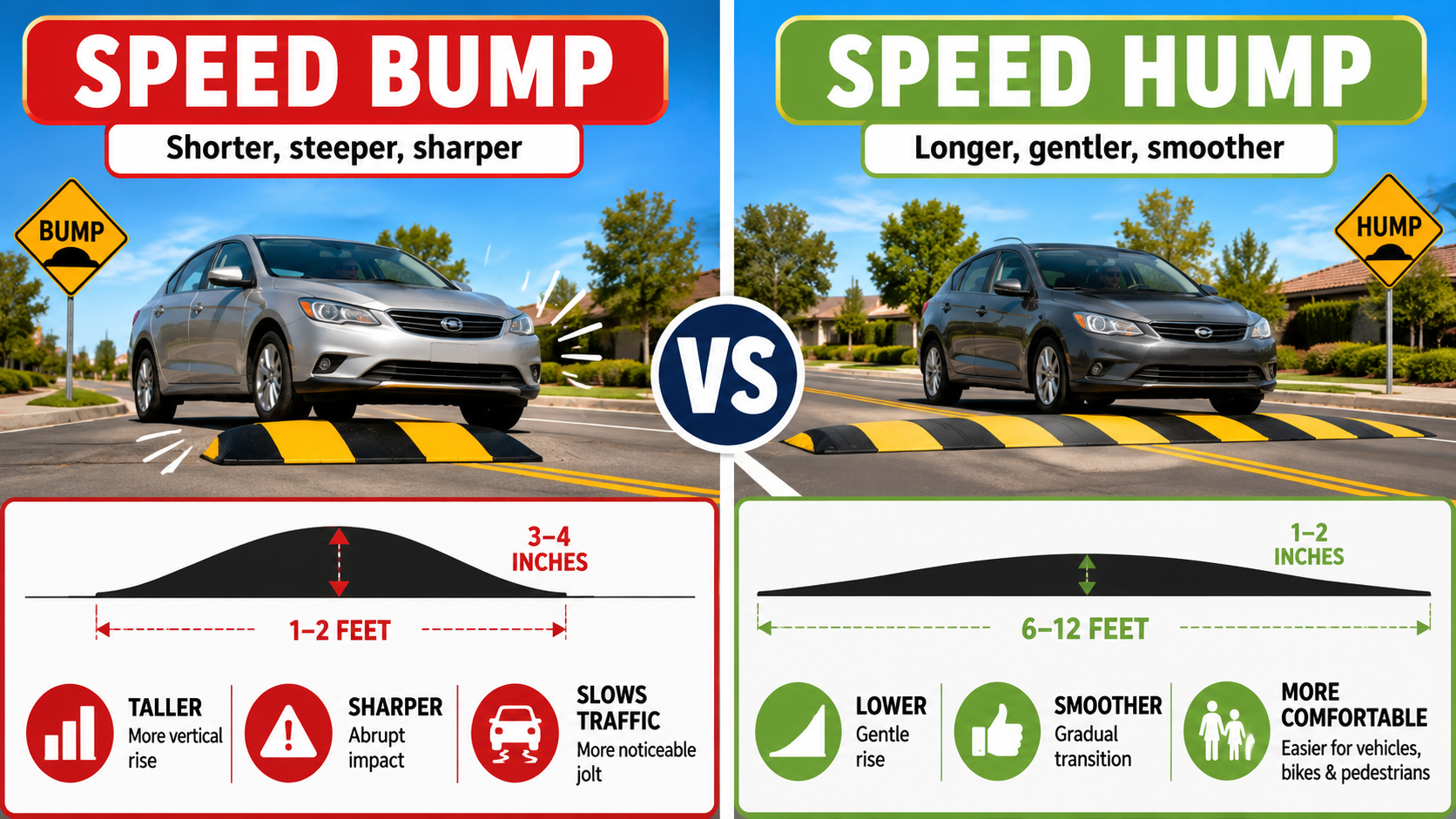
Speed humps are generally less aggressive than speed bumps, allowing vehicles to pass over them at higher speeds with less discomfort. Speed bumps are designed to bring vehicles to a near-stop, causing significant jolts to anyone on board who doesn't comply.
Speed humps are often installed in series across residential streets to maintain speed reduction over distance, while speed bumps are typically used in smaller, contained areas like car parks and private driveways where pedestrian and vehicle interaction is consistently high.
Speed bumps and humps are vertical traffic-calming devices designed to force drivers to slow down. Both work through vertical deflection, making it physically uncomfortable to drive fast, but the level of discomfort, the speeds they target, and where they can legally be used are very different.
Here's the key comparison at a glance:
Speed Bumps
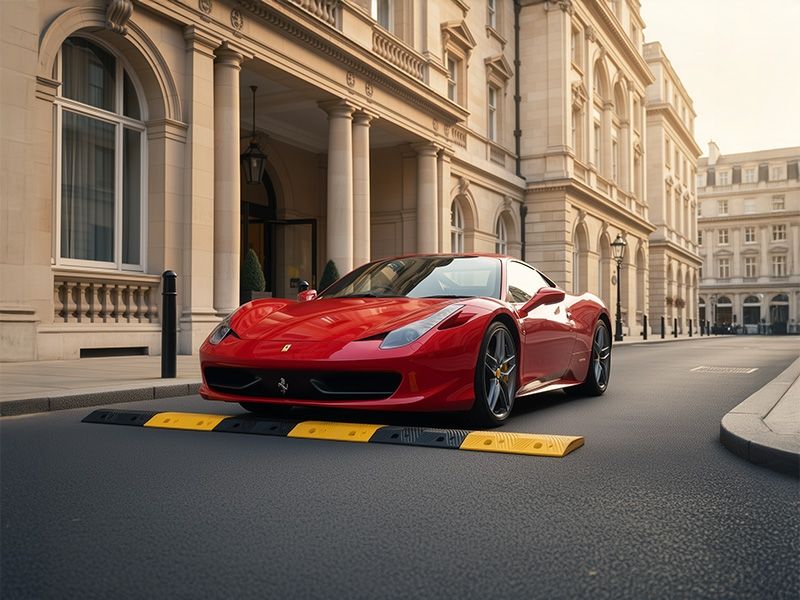
Speed bumps are short, narrow, and deliberately abrupt. The concept of the first speed bump emerged as a simple raised road surface designed to force vehicles to slow down, and the core principle hasn't changed much since.
A speeding vehicle that doesn't slow to near-stop will feel two substantial jolts as the front and rear wheels pass over it separately, with a genuine risk of suspension damage at normal road speeds.
Key characteristics:
- Height: 75–100mm
- Length: 300–900mm (short travel distance means both axles hit the bump separately)
- Target vehicle speed: 2–10 mph (3–16 km/h)
- Also known as: sleeping policemen, judder bars, road turtles, traffic control bumps, speed breakers
- Suitable for: private roads, car parks, driveways, parking lots
- Not permitted on: public roads in the UK
Because speed bumps force vehicles to a near-stop, they're the right traffic calming device for locations where very low speeds are essential and pedestrian and vehicle interaction is high. Think entrance barriers, car park checkpoints, and private estate roads.
Speed bumps are not suitable for bus routes, emergency routes, or any road where slowing traffic to near-stop would cause problems. The double-jolt effect is precisely why they're restricted to private use.
Our rubber speed bumps and speed bump kit are made from high-visibility recycled rubber and come with fixing bolts for both concrete and tarmac surfaces, making them straightforward to install on most private sites.
Speed Humps
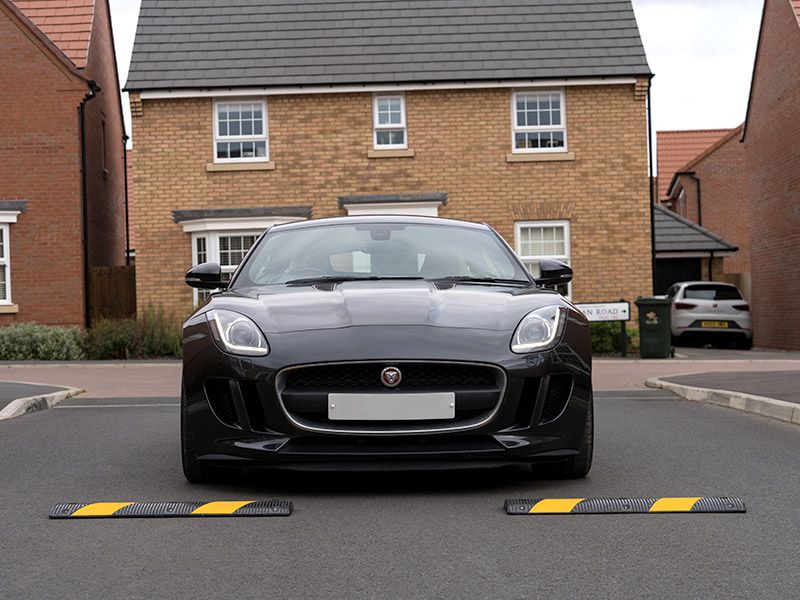
Speed humps are longer, and far less aggressive than speed bumps. Essentially speed humps are engineered municipal tools used to regulate continuous traffic flow on public roads, slowing vehicles without bringing them to a complete stop.
Key characteristics:
- Height: 75–100mm
- Length: 900–3,700mm (full wheel rotation across the hump)
- Target vehicle speed: 10–15 mph (15–25 km/h)
- Also known as: road humps
- Suitable for: public residential roads, school zones, local streets
- Not permitted on: arterial roads, emergency routes, bus-only lanes
The longer travel distance is what makes speed humps gentler. Both axles pass over the full width of the hump in sequence, producing a gentle rocking sensation rather than two sharp jolts. Passenger car occupants feel the movement, but it doesn't threaten vehicle components at the intended speed.
According to a House of Commons Library briefing on road humps and 20mph speed limits, Transport for London data shows that traffic calming on 20mph roads produced:
- A 25% decrease in total collisions and collisions resulting in death or serious injury
- A 36% reduction in collisions involving vulnerable road users
- A 63% reduction in collisions involving people walking
When installed in series, speed humps also produce a measurable reduction in traffic volume as drivers divert to alternative routes, with the scale of that shift depending on the availability of those routes.
To achieve that continuous speed reduction over a long corridor, speed humps are typically placed 110–170m (350–550 ft) apart. A single hump slows traffic past that point. A series of humps maintains slow traffic across an entire residential area or school zone.
Our speed hump includes a central cable channel, allowing cables to run underneath the device without disrupting the road surface or the installation itself.
Speed Tables: The Flat Top Solution
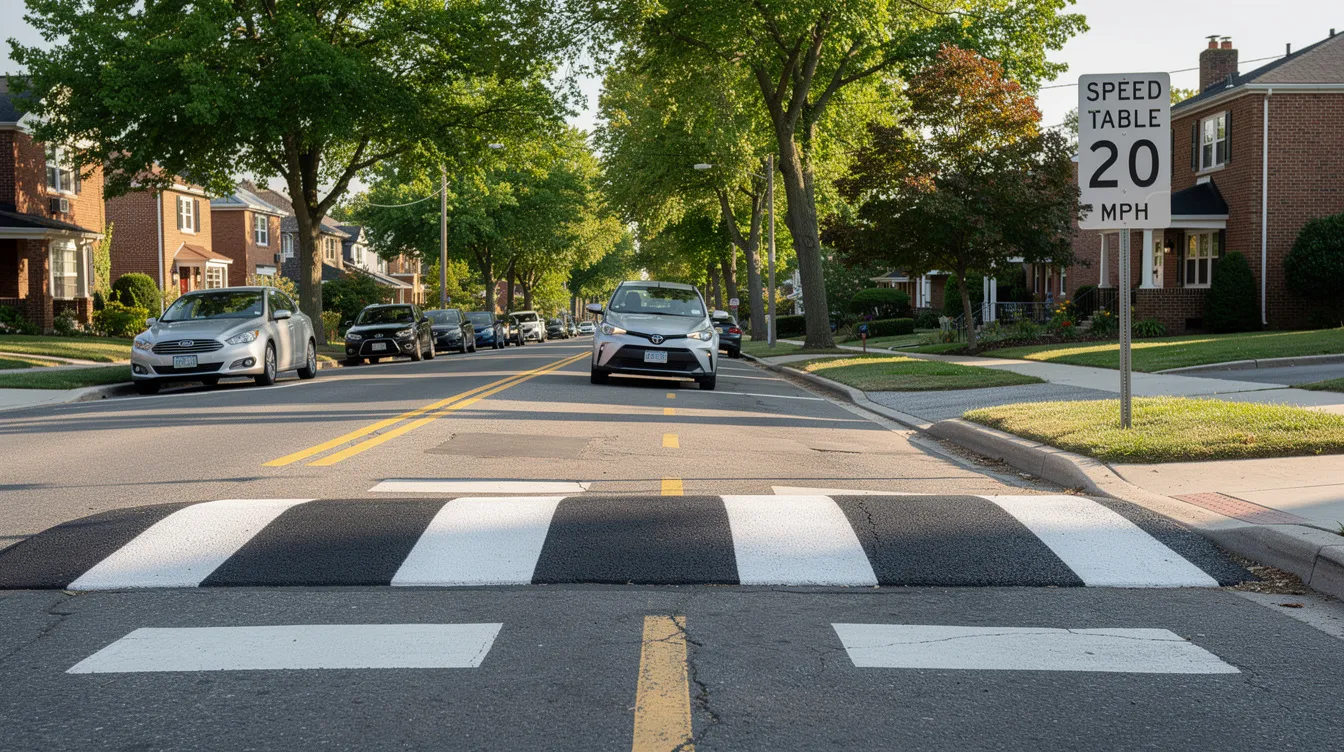
Speed tables take the speed hump concept and extend it further. The top surface is flat rather than curved, giving the device its characteristic flat top profile, and the entire wheelbase of a vehicle passes over it at once.
Key characteristics:
- Flat top design: the vehicle's full wheelbase sits level on the surface simultaneously
- Longer than standard humps, typically 6–9 metres in length
- Produces a smooth, level ride at reduced speed rather than a rocking motion
- Commonly used at pedestrian crossings as a raised crossing point
- Suitable for bus routes and routes where driver and passenger comfort matters more
Because a speed table doesn't pitch the vehicle at an angle, it's far less disruptive to larger vehicles and their loads. It's also the preferred solution at pedestrian crossings: the raised flat surface naturally slows traffic while providing a level crossing point for pedestrians, cyclists, and wheelchair users crossing separately.
Where a standard speed hump would cause unacceptable discomfort on a bus route, a speed table allows buses to pass at a controlled speed without jarring passengers.
Speed Cushions: The Emergency Vehicle Exception
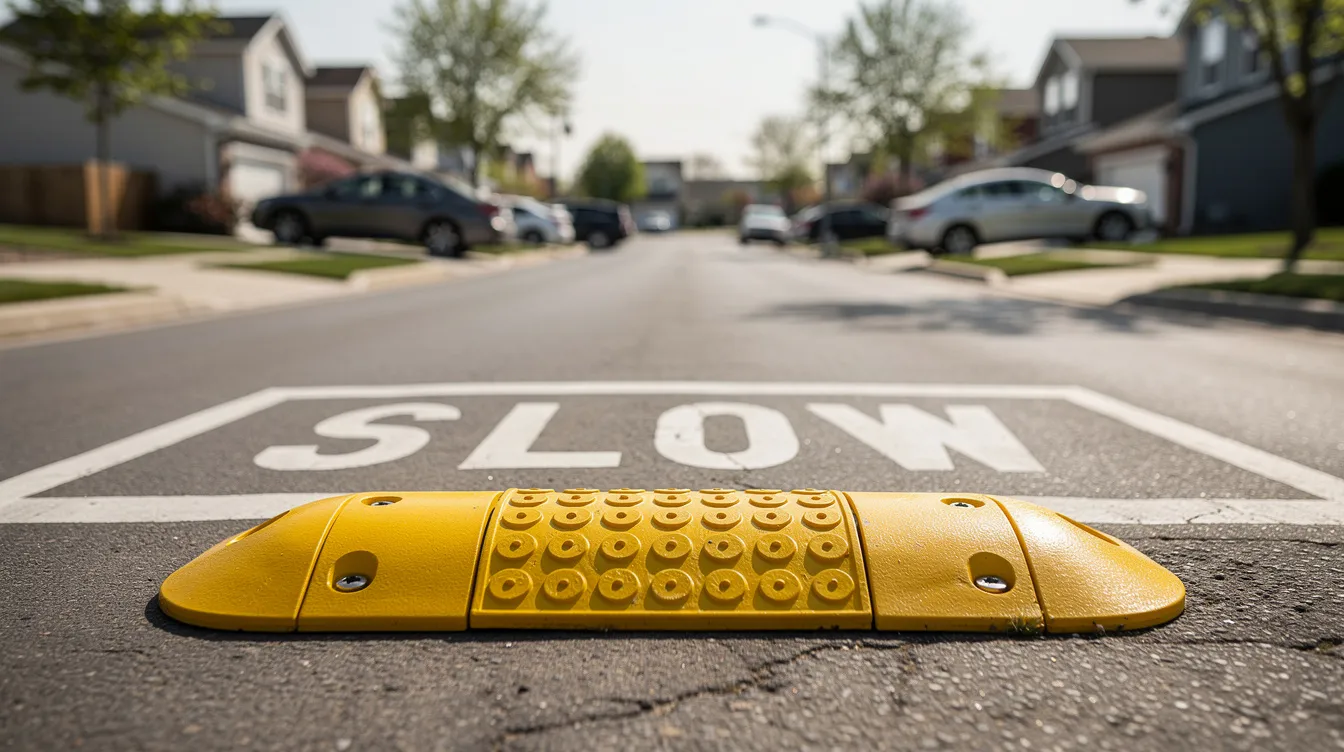
Speed cushions solve a specific problem: how do you slow regular vehicles without also slowing ambulances, fire engines, and police cars?
The answer lies in vehicle width. Speed cushions are narrower than the full width of the road, which means:
- Standard passenger cars and vans: wheels land on the cushion, forcing a speed reduction to 15–20 mph
- Emergency vehicles and buses: wider axles allow them to straddle the cushion and pass without slowing
- Cyclists: can pass through the gap between cushions without deflection
- Standard speed humps can delay emergency responders by 3–10 seconds per hump. On a route with multiple humps, that delay compounds quickly. Speed cushions are the practical compromise that municipalities increasingly favour for:
- Emergency routes where response times are critical
- Bus routes where full-width humps would cause passenger discomfort and schedule delays
- Bike lanes where cyclists need to cross separately from vehicles
- Local streets where emergency access must remain unimpeded
Cities often use speed cushions or speed tables to allow larger vehicles to straddle them without compromising road safety for regular traffic.
Traffic Calming: Where the Speed Limit Alone Isn't Enough
A posted speed limit tells drivers the maximum traffic speed permitted on that road.
A speed hump or speed bump is self-enforcing: it physically compels compliance regardless of driver behaviour. That distinction matters in locations where drivers routinely ignore the posted speed limit.
Effective traffic calming measures match the device to the location and the target speed:
- Residential areas with a 20 mph limit: speed humps placed in series to maintain the speed reduction across the whole street, not just at one point
- School zones: speed bump kits at entrance and exit points, where pedestrian and vehicle interaction peaks during drop-off and collection
- Car parks and private roads: speed bumps at entry points and key junctions, where very low speeds are essential for safety
- Pedestrian crossings on public roads: speed tables that raise the crossing point and calm approaching traffic at the same time
- Emergency routes on residential roads: speed cushions that slow regular traffic without delaying emergency vehicles passing through
Traffic calming is not one-size-fits-all. The wrong device in the wrong location creates new problems: excessive speed reduction that causes congestion, vehicle damage from undersized or overly aggressive humps, or emergency route delays from full-width devices where speed cushions should have been used instead.
Traffic noise is another factor worth considering in residential areas: vehicles braking and accelerating around speed humps can increase localised noise levels, so placement and spacing should account for nearby properties as well as the target speed reduction.
Installation: Speed Bumps and Speed Humps Explained
The installation process depends on the device material and the surface it's going onto.
Speed bumps and speed humps are usually made from rubber or asphalt, with options also available in plastic and concrete. The right material depends on whether you need a permanent installation or a flexible one you can reposition as your site changes.
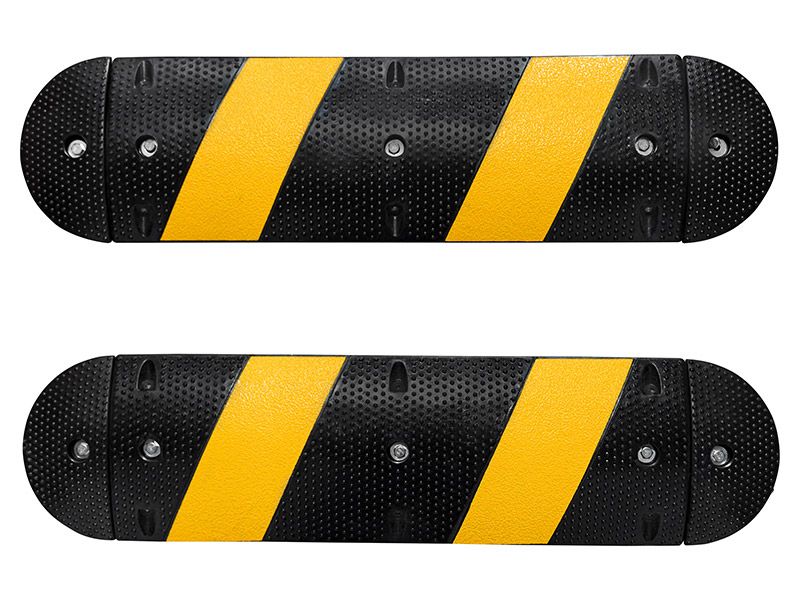
Rubber and Plastic Devices
- Bolted directly onto the existing road surface: tarmac or concrete
- No groundworks or specialist surfacing required
- Rapid to install and straightforward to relocate if site conditions change
- Our speed bump kit comes with fixing bolts pre-included for both concrete and tarmac
Concrete and Asphalt Devices
- Require precision layering of asphalt to achieve the correct profile height
- Concrete speed humps are a permanent installation requiring proper groundworks
- Higher cost and longer lead time than modular rubber or plastic options
- Better suited to high-volume traffic environments where durability is paramount
Warning Signs and Legal Requirements
If you're installing speed humps on a public road in the UK, specific requirements apply under the Highways (Road Humps) Regulations 1999:
- Road humps are not permitted on roads with a posted speed limit above 30 mph
- Warning road signs must be displayed on the approach to each hump
- Humps must not be installed on arterial roads or emergency routes
- Local authority approval is required before installation begins
Rubber and plastic speed bumps on private land do not require local authority approval. Warning signs are still strongly recommended for driver safety and to prevent suspension damage claims from vehicles passing over at unsafe speed.
Full Width vs Narrower Devices: Choosing the Right Profile
One of the key decisions when specifying a traffic calming device is whether it should span the full width of the road or leave gaps at the sides.
- Full width devices (standard speed humps and speed tables): slow all vehicles equally, including emergency vehicles. Best for residential areas and school zones where emergency response times are less critical.
- Narrower devices (speed cushions): allow wider-axle vehicles to straddle them. Best for emergency routes, bus routes, and roads with bike lanes that need to remain clear.
The profile also affects how vehicles pass over them. A full-width hump produces one consistent movement across the road. A speed cushion produces a side-loaded movement in smaller vehicles, which some drivers find less predictable.
Other Traffic Calming Devices
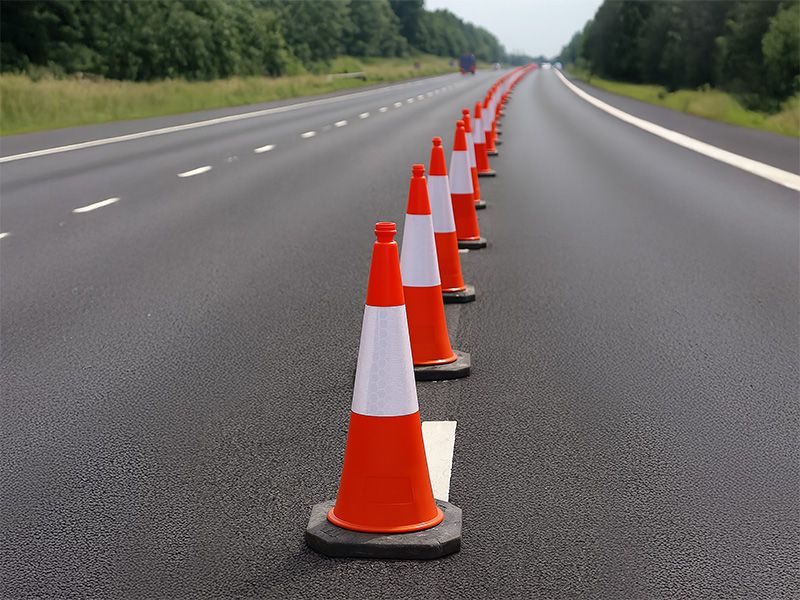
Speed humps and speed bumps are the most visible traffic calming tools, but they're not the only options. Depending on your site, these devices may be more appropriate or work well alongside vertical deflection:
- Road cones: temporary traffic management during works, events, or hazardous conditions where a permanent device isn't appropriate
- Traffic barriers: physical separation of vehicle and pedestrian zones, or restriction of access to certain areas on private sites
- Parking posts: prevent access to specific bays or areas entirely, reducing traffic volume at source rather than managing it once it's arrived
- Warning signs: the posted speed limit sign is the first line of defence before vertical deflection is needed, and legally required as an approach warning on any public road hump installation
For many sites, combining two or more methods produces better results than any single device alone. A speed hump in series with clear warning signs, road markings, and a posted speed limit reinforces the speed reduction at every level and leaves drivers in no doubt about the expected behaviour.
Frequently Asked Questions
What is the main difference between a speed bump and a speed hump?
A speed bump is short (300–900mm long) and forces vehicles to near-stop at 2–10 mph. A speed hump is longer (900–3,700mm), allows vehicles to pass at 10–15 mph, and produces a gentler rocking motion rather than sharp jolts. Speed bumps are restricted to private roads and car parks; speed humps are engineered for public residential roads.
Can speed bumps be installed on public roads in the UK?
No. Speed bumps are not permitted on public roads in the UK due to the extreme speed reduction and vehicle stress they cause. Public roads use speed humps, speed tables, or speed cushions, all of which are regulated under the Highways (Road Humps) Regulations 1999.
What speed do vehicles travel over speed humps?
Speed humps are designed to reduce vehicle speeds to 10–15 mph (15–25 km/h) at the hump itself. When installed in series 110–170m apart, they produce a sustained speed reduction of 13–16 km/h across the full length of the road.
Do speed humps affect emergency vehicles?
Standard full-width speed humps can delay emergency vehicles by 3–10 seconds per hump, which compounds significantly on longer routes. Speed cushions are the preferred alternative on emergency routes, as wider-axle vehicles can straddle the cushion and pass without slowing down.
What is the difference between a speed hump and a speed table?
A speed hump is curved and causes the vehicle to pitch slightly as each axle crosses it separately. A speed table has a flat top surface, meaning the vehicle's full wheelbase sits level on the raised surface simultaneously.
Speed tables are smoother for larger vehicles and buses, and are commonly used at pedestrian crossings.
Are speed bumps and speed humps made from the same materials?
Both are available in rubber, plastic, asphalt, and concrete. Rubber and plastic options bolt directly to an existing surface and can be installed quickly without groundworks. Asphalt and concrete speed humps require precision layering and are a permanent installation. For most private and commercial sites, rubber modular options offer the best balance of cost, durability, and ease of installation.
Choose the Right Traffic Calming Device for Your Site
Speed bumps and speed humps look similar but work very differently. Speed bumps force vehicles almost to a stop and are limited to private roads and car parks. Speed humps are engineered for public residential roads, slow traffic to 10–15 mph, and reduce both traffic volume and collision rates when installed in series. Speed cushions and speed tables extend the range of options further, solving specific problems that standard humps cannot.
If you're specifying traffic calming for a private road, car park, or commercial site, our speed bumps and ramps range covers rubber speed bumps, speed humps with cable channels, and speed bump kits for residential and commercial use. Free next-day delivery is available on orders placed before 3pm.
Posted in Health and Safety