

Falls from height remain the leading cause of fatal workplace injuries in Great Britain.
When something goes wrong, one of the first questions the HSE asks is not "did you buy a good ladder?" It's "where are your inspection records?"
That's the part most ladder inspection guides miss. They tell you what to look at. This one covers both: a complete, free ladder inspection checklist you can use immediately, and the documentation framework that proves compliance under the Work at Height Regulations 2005. Because an inspection that wasn't recorded is, legally speaking, an inspection that never happened.
Free Ladder Inspection Checklist
Use this as a quick-reference guide for your team. It covers all six structural checks a competent person needs to complete during a detailed ladder inspection, in the correct sequence.
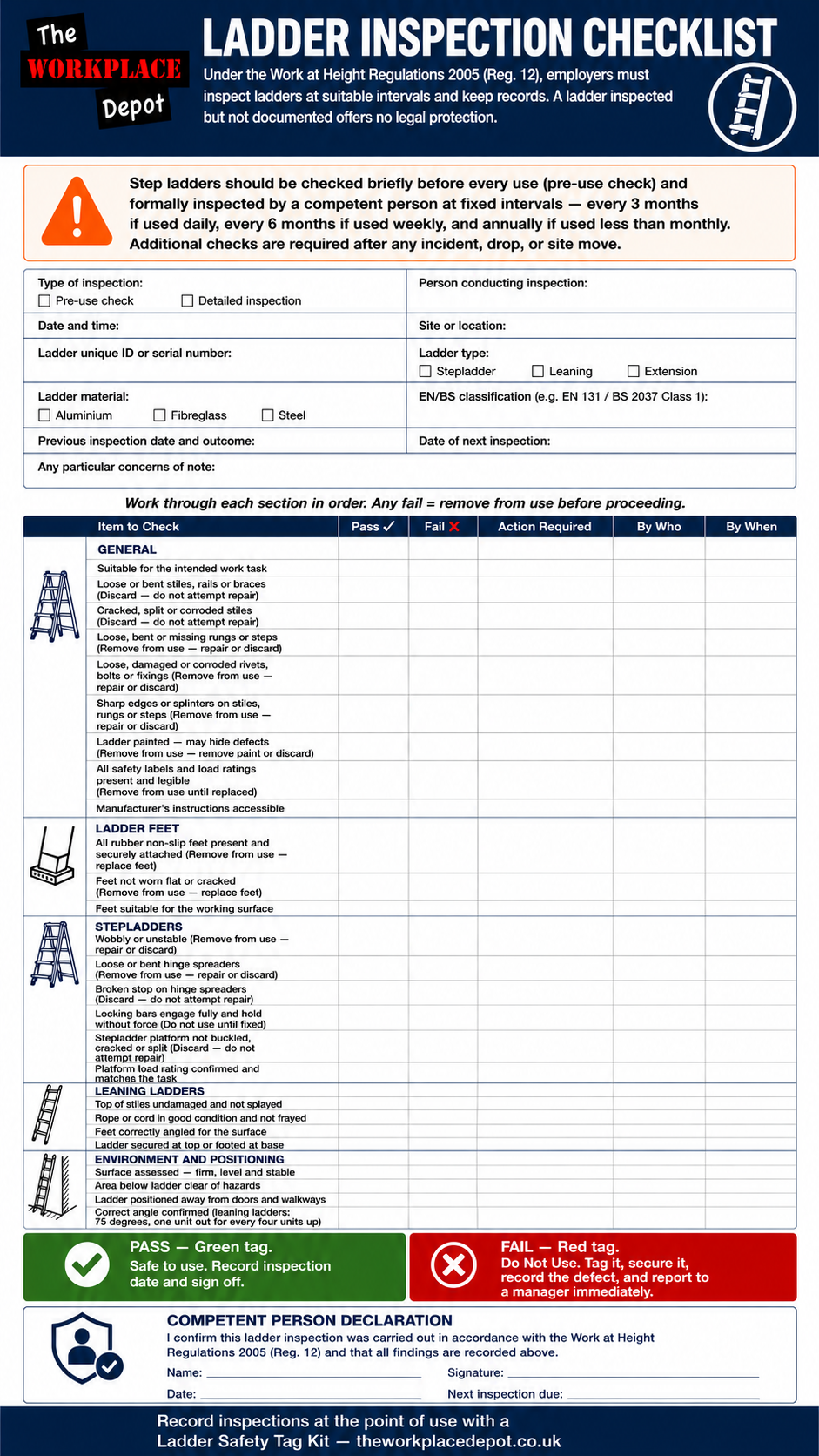
Your Free Ladder Inspection Checklist Explained
What follows is a structured checklist for detailed visual inspections carried out by a competent person. Pre-use checks follow the same points but at a quick glance rather than in depth. Work through this in sequence; inspections provide a snapshot of the state of the ladders at that moment in time, so consistency matters.
1. Stiles and Side Rails
Inspect each stile along its full length. You're looking for:
- cracks
- dents
- bends
- corrosion (and on metal ladders)
- damaged welded joints and loose rivets
Check that fixings aren't bent and that there are no sharp edges along the rail. Any of the above defects to the structural rails means the ladder comes out of service.
On fibreglass ladders, look for delamination, deep scratches, or splinters. Minor surface marks are normal; anything that compromises the integrity of the rail is not.
2. Rungs, Steps and Treads
Each rung must be firmly attached, undamaged, and straight. A bent rung, or one that moves under load, is grounds for immediate removal.
On step ladders, check that treads are intact and the non-slip surface is in good condition. Keep treads free of debris. Not the dirt itself that's the issue, but contamination can conceal surface damage beneath it.
3. Ladder Feet
All rubber non-slip feet must be present and securely attached. Check the actual feet, not just the bottom of the stile, for wear. Feet worn flat on a solid surface like a dirty workshop floor or paving slabs will give significantly less grip than they should.
Note, too, that ladder feet behave differently on different surfaces: on eg soil, dug soil, or ground with embedded stones, you'll need a firm base plate or a solid surface beneath the feet before the ladder is safe to use.
If any feet are missing, cracked, or worn flat, the ladder doesn't pass.
4. Locking Mechanism, Stays and Accessories
The locking mechanism must work properly and engage fully before the ladder is used.
On step ladders, locking bars must lock positively into position; they shouldn't require force to hold and they shouldn't rattle when the platform is loaded. Check that spreader stays are undamaged and fully engaged. Any damaged stays mean the ladder is unsafe.
Where stability devices or other accessories are fitted, check those too. Anything that's damaged, missing, or not functioning in accordance with the manufacturer's instructions should be flagged.
5. Stepladder Platform: Check for Safe Use
The standing platform must not be buckled, cracked, or split. Confirm it's clear and level before the ladder is used.
The Workplace Depot's warehouse step ladders include platform models load-tested to 300kg, but the rated capacity is only meaningful if the platform itself is in good condition. Note the load rating on your inspection record, and flag it if the task demands more than the equipment is rated for.
6. Labels and Safety Markings
All safety labels and load ratings must be present and legible.
If labels are damaged or missing, you have no way of confirming the ladder's rated capacity at the point of use, and neither does the person picking it up at 6am. Remove the ladder from service until markings are restored in accordance with the manufacturer's instructions.
Why Ladder Inspections Are a Legal Requirement, Not a Tick-Box Exercise
What the Work at Height Regulations 2005 Actually Require
Regulation 12 of the Work at Height Regulations 2005 places a clear legal duty on employers: all equipment used for work at height, including ladders, must be inspected at suitable intervals and after any exceptional circumstances that could affect its condition.
"Suitable intervals" isn't a fixed number handed down by the height regulations. It's risk-based, and it has to be determined through a ladder risk assessment. What that means in practice is that you decide the frequency based on how often the equipment is used, in what conditions, and what the consequences of a failure would be. You then stick to that schedule, and you document it.
This is where many employers fall short. According to HSE guidance on working at height, poor or missing records of these inspections are treated as non-compliance, even where the equipment itself is in good physical condition. If an HSE inspector arrives and you can't produce a current inspection record, you're exposed, regardless of whether the ladder would have passed.
The Cost of Missing Records
Without documented ladder inspections, an employer cannot demonstrate due diligence. Under the Health and Safety at Work etc. Act 1974, that can mean prosecution, improvement notices, prohibition notices, and in serious cases, substantial fines.
The risk is real. In 2009, a 65-year-old worker fell 1.8 metres from a damaged ladder while cleaning inside commercial premises. The ladder had never been inspected. His employer had no documentation showing any checks had taken place. He died from his injuries four days later. The absence of records didn't just mean regulatory trouble; it meant there was no evidence that anyone had ever tried to make the situation safe. You can read more about the importance of working at height safety and choosing the right equipment.
That's the scenario your inspection records exist to prevent.
Who Should Check a Ladder Before It Is Used?
There are two distinct roles in any compliant ladder inspection process: the ladder user and the competent person. They have different responsibilities, different levels of scrutiny, and different documentation requirements.
The Ladder User: Pre-Use Checks
Before starting any work task involving a ladder, the user should carry out a basic visual check. This takes under a minute and covers the condition of the equipment at that moment. You're looking for anything obviously wrong: visible defects, missing feet, a locking mechanism that doesn't engage, or anything that would make it unsafe to use a ladder for the job.
Pre-use checks don't need to be recorded. But they must happen every time, without exception. If a user spots a defect, the ladder must be taken out of use and reported to a manager immediately.
The Competent Person: Detailed Visual Inspections
Detailed visual inspections are carried out by a competent person: someone with the training, knowledge, and practical experience to spot defects, understand inspection criteria, and make a sound judgement about whether a ladder is safe to return to service.
That doesn't mean you need an external contractor. A competent employee who has been properly trained can fulfil this role. What matters is that they genuinely understand what they're looking for, not just that they've been handed a form to fill in. According to HSE ladder inspection guidance, a qualified person should be familiar with the manufacturer's instruction manual and the ladder's intended use.
The detailed inspection is where the documentation obligation sits. These records are what need to be recorded, and what the employer relies on if something goes wrong.
How Often Should Ladders Be Inspected?
Pre-Use Checks: Before Every Task
Simple rule: every time a ladder is going to be used, the person using it checks it first. There are no exceptions.
Detailed Inspections at Fixed Intervals
The inspection frequency you set should reflect how the equipment is actually used:
- Ladders used daily: detailed visual inspection every 3 months
- Ladders used weekly: every 6 months
- Ladders used less than monthly: annual inspections
In a demanding environment (a busy warehouse, a construction site, or outdoors), you may want to inspect more frequently. The right frequency is the one your risk assessment determines, not the one that's most convenient.
It's worth noting that scaffold inspection requirements are different: scaffold systems must be inspected every seven days by law. Ladders don't have that fixed legal interval, but the principle is the same: regular checks at fixed intervals, properly documented.
When Additional Checks Are Required
A detailed inspection should also take place after any exceptional circumstances: if a ladder has been dropped, involved in an incident, moved between sites, or used in an unusually harsh environment.
If a defect is found during a pre-use check and the ladder is repaired, a competent person must re-inspect it before it goes back into service.
How to Document Inspections: What an Audit-Ready Record Looks Like
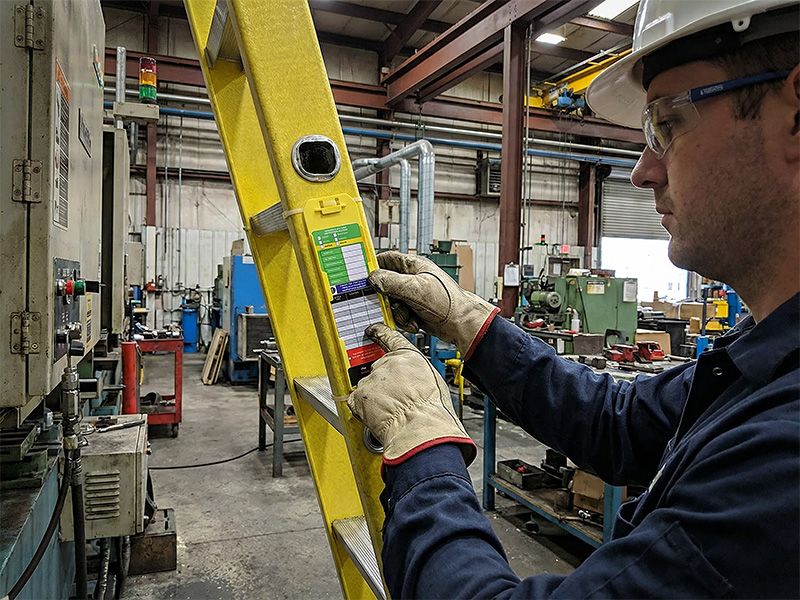
What a Valid Inspection Record Must Include
An up to date record for each ladder inspection should contain, at minimum:
- Date of inspection
- Name and signature of the competent person
- A unique identifier for the ladder (serial number or asset tag)
- Each item inspected and the outcome
- Any defects found and the action taken
- The date of the next scheduled inspection
Records need to reflect the current safe condition of each piece of equipment. An inspection record from 18 months ago demonstrates that the ladder was safe then, not that it's safe now. Inspections provide value precisely because they're carried out at fixed intervals and kept up to date.
Recording Checks at the Point of Use
Here's where most organisations have a gap: the records exist, but they're in a folder in the facilities office. The person who picks up the ladder at 7am has no idea when it was last checked, or whether it passed.
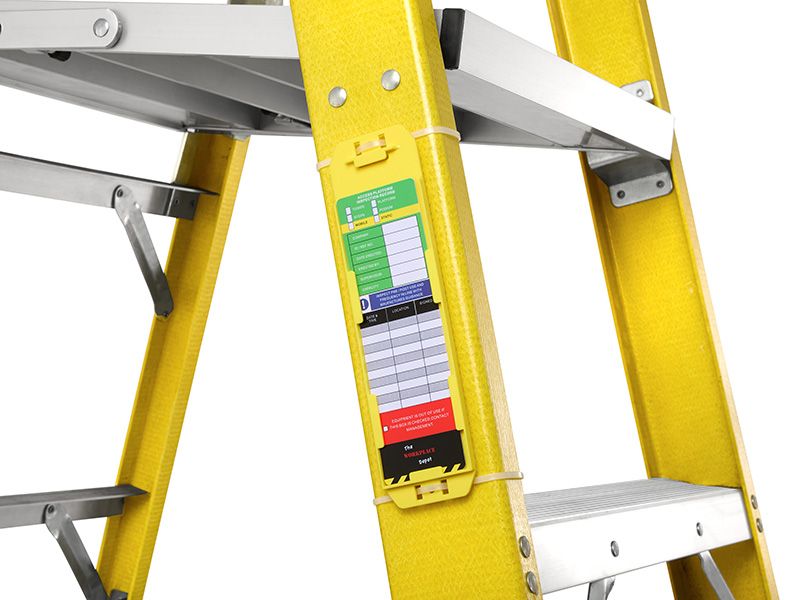
The Ladder Safety Tag Kit from The Workplace Depot closes that gap by keeping the inspection record on the ladder itself. Colour-coded tags show pass or fail status at a glance, even from a distance or in low light, so any member of the team can make an informed decision before they climb, without needing to locate a filing cabinet first.
Pre-printed fields for inspection date, signature, and result mean every record looks uniform across your ladder fleet. There's no ambiguity about what was inspected or when.
When a new inspection is due, the quick-swap inserts mean you're replacing a card rather than the entire tag; the permanent holder stays fixed to the ladder, the insert pops out, and a fresh one goes in within seconds.
The kit fits all ladder types, including step ladders, roof ladders, and models with levellers, so you can roll out one consistent system across your entire site.
For facilities managers overseeing multiple locations, that standardisation is an immediate benefit: every ladder, everywhere, documented in the same format and visible at the point of use.
Any ladder that fails inspection must be tagged "Do Not Use" and secured so it can't be picked up by mistake. Maintained properly, a well-tagged fleet also tells you at a glance which ladders are due for their next check, which makes scheduling significantly easier.
Ladder Risk Assessment: Where Inspections Fit In
Ladder inspections are one component of a broader compliance framework. The legal requirements for ladder inspections under UK law cover more than the checklist itself.
The risk assessment determines which equipment is appropriate for a task, how frequently inspections should occur, who is competent to carry them out, and under what surface conditions the equipment may be used.
It's also worth noting that under the Work at Height Regulations 2005, you should only use a ladder where the risk assessment concludes that lower-risk alternatives aren't reasonably practicable. If a job is going to be carried out repeatedly from the same position, or requires carrying significant loads, a mobile safety platform may be a safer option.
Our full range of safety steps and ladders includes options for warehouse, industrial, and office environments.
If you're unsure which type of access equipment suits your task, the safety steps range is a good starting point.
Inspections provide a snapshot of the state of the ladders at a given point in time. The risk assessment is what ensures the right equipment is being inspected in the first place.
Frequently Asked Questions
What is the legal requirement for ladder inspections in the UK?
Under Regulation 12 of the Work at Height Regulations 2005, employers must ensure that ladders and other work at height equipment are inspected at suitable intervals and after any exceptional circumstances.
The frequency should be determined by risk assessment. Records of these inspections must be kept and made available to enforcement authorities on request.
Who should check a ladder before it is used?
The ladder user should carry out a pre-use check before every task: a quick visual inspection for obvious defects that takes under a minute. Separately, a competent person must carry out detailed visual inspections at fixed intervals.
These are the inspections that need to be recorded. Pre-use checks don't require documentation, but they must happen every time.
How often should ladders be inspected?
As a guide, ladders used daily should receive a detailed visual inspection every three months; ladders used weekly, every six months; and ladders used less than monthly, annually.
The correct frequency for your situation should be determined by risk assessment and will depend on the conditions in which the equipment is used.
What should a ladder inspection checklist include?
A thorough ladder inspection covers: stiles and side rails (cracks, bends, corrosion, loose rivets, damaged welded joints on metal ladders); rungs, steps, and treads (secure, non-slip, undamaged); ladder feet (present, securely attached, not worn flat); locking mechanism and stays (fully engaged, no damage); stepladder platform (not buckled or split); and labels and safety markings (present and legible).
What happens if a ladder fails inspection?
Any ladder that fails inspection must be immediately removed from use, clearly tagged "Do Not Use", and secured so it can't be picked up by mistake. The defect should be recorded. The ladder can only return to service once it's been repaired by a qualified person and re-inspected by a competent person. If it can't be safely repaired, it should be disposed of.
How do I record ladder inspections to comply with Work at Height Regulations?
Records should include the inspection date, the competent person's name and signature, the ladder's unique identifier, the outcome for each item inspected, any defects found and action taken, and the next inspection date. To make records accessible at the point of use, the Ladder Safety Tag Kit attaches the inspection record directly to the ladder, with colour-coded pass/fail tags and quick-swap inserts that update in seconds.
Keep Your Team Safe and Your Records Watertight
Three things to take away from this guide. There are two types of check: the pre-use check carried out by the ladder user before every task, and the detailed visual inspection carried out by a competent person at fixed intervals. There are two parties responsible. And there's one thing the Work at Height Regulations 2005 require above all else: records that demonstrate due diligence.
A thorough ladder inspection checklist is only as useful as the documentation it generates. If you can't show when each ladder was checked, who checked it, and what the outcome was, you don't have a defensible compliance position.
The Ladder Safety Tag Kit is the simplest way to close that gap. It keeps the inspection record on the ladder itself, colour-coded, pre-printed, and visible before the first rung, rather than in a folder that nobody checks until it's too late. Order before 3pm for free next-day delivery.
Posted in Health and Safety