

Every construction site requires a core arsenal of tools, safety equipment, and compliance documents to function efficiently and legally. Essential construction site tools include safety equipment, measuring tools, hand tools, and power tools, but the full picture goes further than that.
You also need the right site infrastructure, properly trained workers, and a set of legal documents in place before a single nail is driven.
This guide covers everything a construction project needs: from PPE and power tools to site fencing, welfare facilities, and the paperwork that keeps your project on the right side of UK law.
Setting Up a Construction Site: Infrastructure First
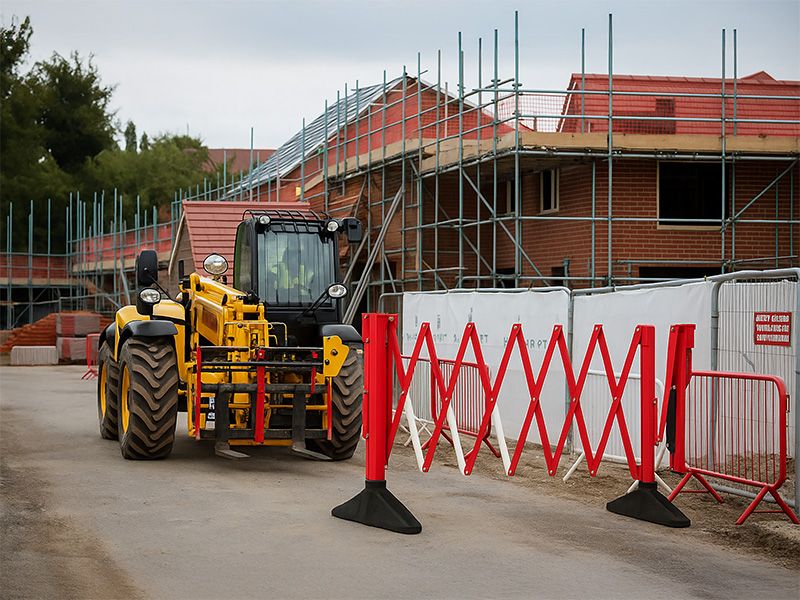
Before tools come out of the van, your construction site needs to be set up properly. Establishing a secure perimeter with robust fencing is one of the first steps in any construction site set-up plan, preventing unauthorised access and protecting the public from potential hazards.
Key site infrastructure includes:
- Heavy-duty fencing to secure the perimeter and restrict access to authorised workers and contractors only
- Safety and pedestrian barriers to separate working zones from public areas and manage foot traffic around the site
- Road cones for traffic management on and around the site, particularly during deliveries or where construction activities extend to the roadside
- External cable protectors to shield electrical cables used by tools and temporary power supplies from heavy wheel traffic and site conditions
- Safety signs and labels to communicate mandatory requirements, hazard warnings, and restricted areas clearly to everyone on site
Providing welfare facilities and accommodation for workers is also a practical requirement during construction site set-up. This includes changing areas and secure storage. Metal lockers are a reliable option: durable, secure, and well-suited to site conditions.
Keeping a clean and organised construction site reduces the risk of accidents and improves productivity, as workers spend less time searching for tools and navigating around debris.
Personal Protective Equipment
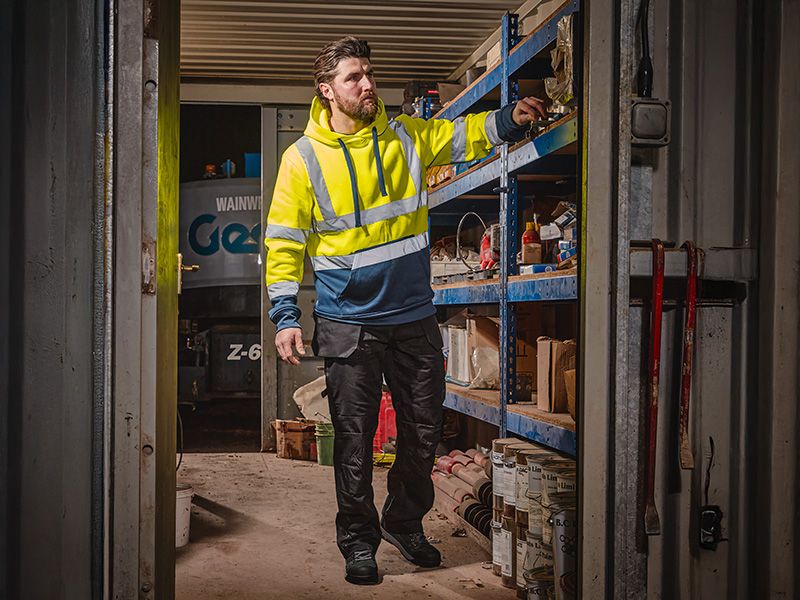
Personal protective equipment is non-negotiable on any construction site. Every worker must be equipped with the appropriate PPE for their role and the specific hazards they face. High-risk activities such as cutting, grinding, demolition, and working at height each carry distinct risks that require specific protection.
Safety Boots
Steel-toed safety boots protect against heavy falling objects, punctures from nails and sharp materials underfoot, and slipping on uneven or wet surfaces. Rubber boots are also appropriate in wet conditions and protect against burns, water, and high temperatures. Look for footwear meeting BS EN ISO 20345 S3 standards. Browse our protective footwear range for options suited to construction environments.
High-Visibility Clothing
High-visibility vests ensure workers are visible to machinery operators, vehicle drivers, and colleagues in all light and weather conditions. Hi-vis clothing should meet EN ISO 20471 Class 2 or Class 3 depending on the level of risk. Find the right options in our workwear range.
Hard Hats
A safety helmet is a commonplace piece of protective gear in construction, designed to protect the head and brain against debris, falling objects, rain, and electric shocks. Hard hats must comply with BS EN 397 and should be inspected regularly for damage.
Gloves, Goggles and Hearing Protection
- Construction gloves protect hands from splinters, cuts, heat, chemical hazards, and general construction-related injuries
- Safety glasses protect the eyes from serious injuries caused by flying chips and fragments during construction activities. Where dust and fine particles are present, goggles or respirators are required
- Hearing protection such as earplugs or earmuffs is essential on construction sites to prevent hearing loss from prolonged exposure to loud machinery and power tools
Power Tools
Power tools are standard across construction projects of every size. Cordless and corded options are used for speeding up labour-intensive tasks including framing, cutting, fastening, and demolition.
Cordless Drill
A power drill is essential in construction for making holes and driving fasteners into wood, metal, concrete, and masonry. Cordless models with multiple torque settings offer the flexibility needed across different tasks and materials.
Circular Saw
A circular saw is one of the most widely used power tools in construction, capable of making straight cuts through wood, plywood, and a range of sheet materials. When cutting wood or sheet material at volume, it's significantly faster than hand sawing and produces cleaner results.
Angle Grinder
An angle grinder handles cutting, grinding, and finishing on metal, concrete, and tile. It's a high-risk tool that requires appropriate PPE including face protection, gloves, and hearing protection. Unplugging and disconnecting power tools such as the angle grinder when not in use is a critical safety measure to prevent accidental injuries on construction sites.
Nail Gun
Nail guns accelerate framing by rapidly driving nails using compressed air or battery power. They significantly reduce labour time on large-scale timber framing, decking, and roofing tasks. Operators must be trained in their safe use before operating on site.
Demolition Jackhammer
Demolition jackhammers are used to break up concrete and asphalt during site clearance and structural modification work. They require full PPE including hearing protection, vibration-dampening gloves, and eye protection.
Regular maintenance of construction tools is essential. Studies indicate that tool maintenance issues can account for around 40% of project overrun costs, making it a direct impact on project efficiency and profitability.
Measuring and Layout Tools
Precision is vital in preventing structural errors in construction. The right measuring tools ensure that every element of a build is aligned, level, and accurate before materials are fixed in place.
- Tape measures are essential for precise measurements at every stage, from setting out foundations to installing fixtures
- Spirit levels ensure surfaces, foundations, and installations are perfectly horizontal or vertical before work progresses
- Laser levels provide accurate vertical and horizontal reference lines across longer distances, particularly useful for large construction projects and multi-storey work
Hand Tools and Building Materials
Hand tools such as chisels and hammers are fundamental in construction, used for cutting, shaping, and driving materials across carpentry, masonry, and general trades.
Essential Hand Tools
- Hammers for driving fixings, framing, and demolition
- Chisels for shaping wood, brick, and stone
- Utility knives for cutting drywall, insulation, and general materials on site
- Screwdrivers and wrenches for fixing and assembly tasks across all trades
- Pliers and wire cutters for electrical and general mechanical work
Building Materials and Handling Equipment
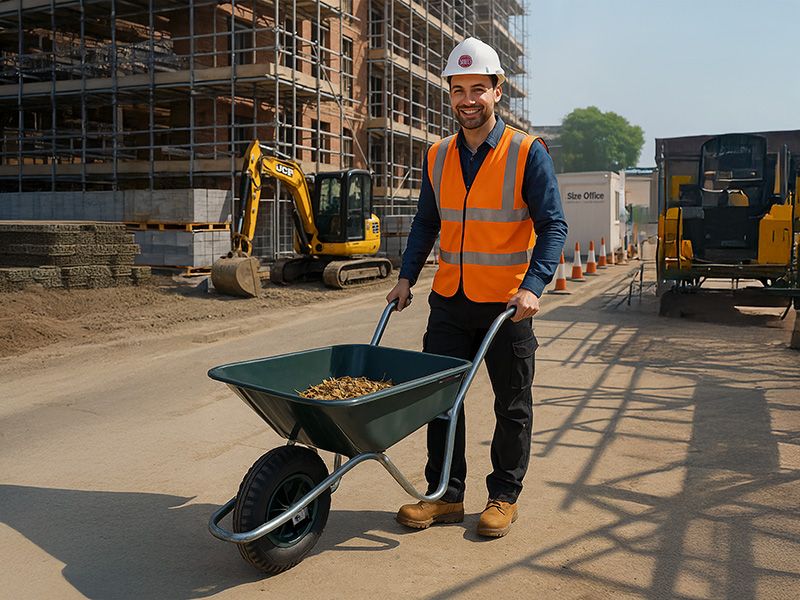
Moving construction materials efficiently and safely is a core part of construction work.
Wheelbarrow trolleys are essential for transporting debris, aggregate, concrete, and heavy materials across site without excessive manual lifting. Concrete mixers combine cement, water, and aggregates to create a consistent mixture for foundations, floors, and structural elements.
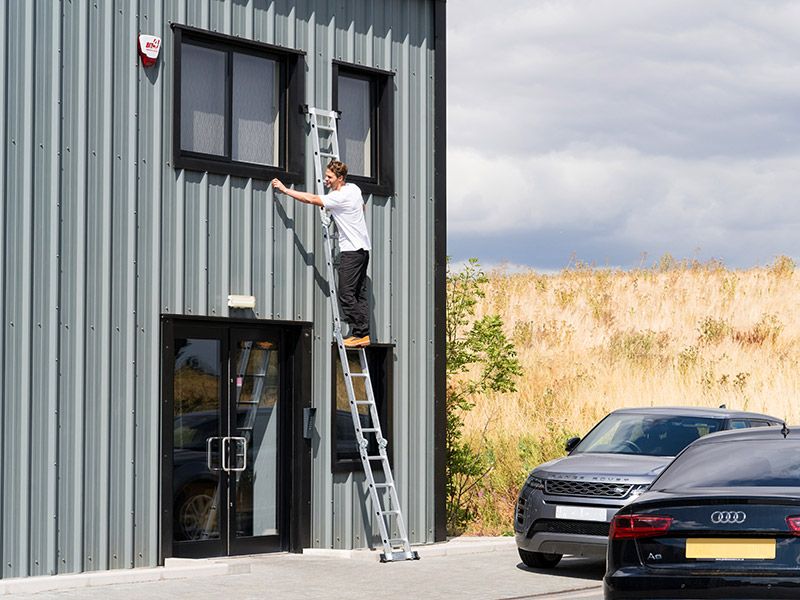
Access to the right platforms and ladders is equally important. Safety steps and ladders provide safe working-at-height access across a wide range of tasks, from plastering and painting to electrical installation and roof work.
Manual Handling on a Construction Site
Manual handling is one of the leading causes of injury in the construction industry. Workers regularly lift, carry, push, and pull heavy materials including bricks, timber, pipe sections, and filled wheelbarrows.
The Manual Handling Operations Regulations 1992 require employers on construction sites to:
- Avoid manual handling tasks that carry a risk of injury wherever reasonably practicable
- Assess unavoidable manual handling operations and take steps to reduce the risk
- Provide adequate training to workers before they are required to carry out heavy or repetitive lifting tasks
Proper handling of tools is also part of this: using a tool belt rather than carrying loose equipment, and never throwing or tossing tools between workers, minimises the risk of injury and dropped loads.
Construction Phase Plan and Legal Documents
A construction phase plan is your site safety plan in writing: a legal requirement under the Construction (Design and Management) Regulations 2015 (CDM 2015), prepared before construction work begins and maintained throughout the project.
It details the health and safety arrangements for the site, including roles and responsibilities, site rules, emergency procedures, and risk control measures.
Alongside the construction phase plan, every site must have the following in place:
Risk Assessment
Risk assessments are mandatory on construction sites and must be project-specific, suitable for the work being carried out, and accessible to workers on site. They identify hazards including falling objects, confined spaces, manual handling, and the use of high-risk machinery, and set out the control measures in place to manage each one.
Accident Book
An accident book is a legal requirement on any construction site. Every incident, however minor it may appear, must be recorded, including the nature of the injury, the circumstances, and the individual involved. Accurate records protect workers, support insurance claims, and help identify patterns that indicate a systemic safety issue requiring attention.
Induction Forms and Training Records
Induction forms are legally required for every construction project. All workers must receive a site-specific induction before they start work, covering site rules, emergency procedures, hazard locations, and the correct use of PPE. Training records should be kept on site and made available for inspection.
HSE Poster
Employers are required by law to display the HSE-approved health and safety law poster in a prominent location on site, or provide each worker with a leaflet containing the same information.
Keeping all relevant paperwork and documentation accessible on-site supports smooth operations and minimises misunderstandings, delays, and risks during construction activities.
Adequate Training for Construction Workers
Adequate training is one of the most effective tools available to any construction site manager. Proper training on the use and maintenance of construction tools is essential to prevent accidents and ensure the longevity of equipment. Construction workers must be trained in:
- The safe operation of every power tool and piece of machinery they use on site
- Manual handling techniques appropriate to the tasks they perform
- The correct use and maintenance of their PPE
- Emergency procedures, including first aid and fire evacuation
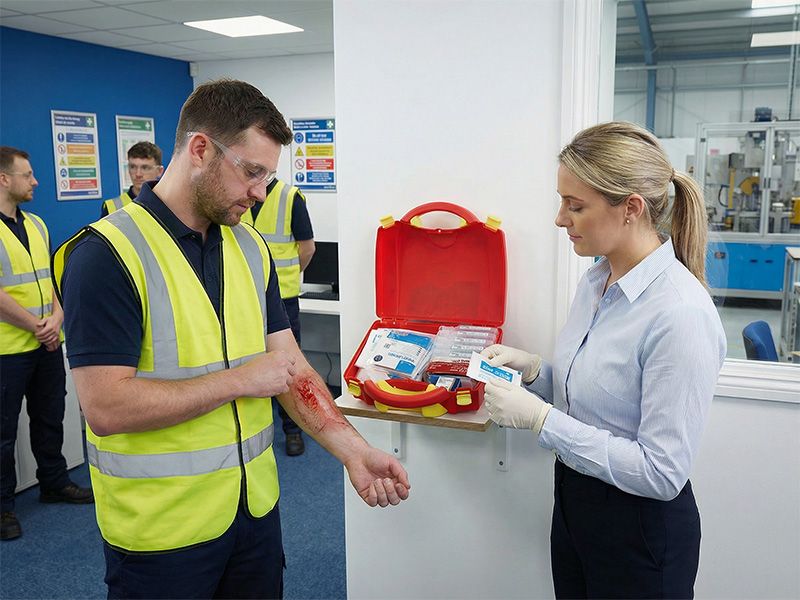
First aid kits must be available on every construction site. Depending on the size of the project and the number of workers, a trained first aider may also be required under the Health and Safety (First Aid) Regulations 1981.
Planning workflows and routines that adhere to health and safety regulations helps work progress efficiently while reducing the risk of accidents or delays on construction sites.
Frequently Asked Questions
What are the most essential tools needed on a construction site?
The core tools needed on a construction site include personal protective equipment (hard hats, safety boots, hi-vis clothing, gloves, and eye and hearing protection), power tools (cordless drill, circular saw, angle grinder, nail gun), measuring tools (tape measure, spirit level, laser level), and hand tools (hammers, chisels, utility knives). Site infrastructure including fencing, barriers, cable protectors, and safety signs is equally essential.
Is a construction phase plan legally required?
Yes. Under the CDM Regulations 2015, a construction phase plan is a legal requirement for every construction project. It must be prepared before work starts and kept updated throughout the project.
What PPE is required on a construction site?
As a minimum, construction workers must wear a hard hat, safety boots (steel-toed, BS EN ISO 20345 S3 standard), and high-visibility clothing. Depending on the task, additional PPE including safety glasses, gloves, hearing protection, and respiratory protection may also be required.
What are the manual handling requirements on a construction site?
The Manual Handling Operations Regulations 1992 require employers to avoid manual handling risks where possible, assess unavoidable tasks, and provide adequate training. Workers must not be required to lift loads beyond safe limits without appropriate controls in place.
Do all construction workers need site inductions?
Yes. Induction forms are legally required for every construction project. Every worker must receive a site-specific induction covering hazards, emergency procedures, PPE requirements, and site rules before they start work.
Equip Your Construction Project from The Workplace Depot
Whether you're setting up a new construction project or reviewing your site safety obligations, The Workplace Depot stocks a practical range of construction site essentials. From safety signs and cable protectors to site barriers, protective footwear, first aid kits, and stepladders, everything is available with free next-day delivery on orders placed before 3pm.
Browse our full health and safety range for more.
Posted in News