

Falls from height are the leading cause of fatal workplace injuries in Great Britain. According to the HSE fatal injuries report for 2024/25, 35 workers died as a result of falls from height in a single year, accounting for over a quarter of all worker fatalities. Many of those incidents involved ladders.
The 3 point contact ladder rule is one of the most practical ways to reduce that risk and should be a top priority on every climb. This guide explains what the rule means, how climbing ladders correctly reduces the risk of falls on different ladder types, and what to do when you genuinely need both hands free at the working position.
What Is the 3 Point Contact Ladder Rule?

The 3 point of contact ladder rule is a fundamental ladder safety guideline recognised across UK workplaces, construction sites, and maintenance environments. It requires you to maintain three points of contact with the ladder at all times while climbing or descending.
Two Hands and One Foot, or Two Feet and One Hand
Three points of contact means you always have either:
Two hands and one foot on the ladder, or
Two feet and one hand on the ladder
At least one hand must grip a ladder rung or side rail, and both feet should be placed firmly on the rungs.
As HSE guidance on the safe use of ladders sets out, three points of contact should be maintained while climbing and, wherever possible, at the working position itself.
Why Three Points of Contact Reduces Falls
Maintaining three points of contact distributes your weight across multiple secure positions, keeping your centre of gravity stable throughout the climb.
If one hand or foot slips, the other two contact points help prevent a fall. It's the simplest, most reliable method of preventing falls on ladders, and one that requires no additional equipment to implement.
Ladder Safety: How to Maintain Three Points of Contact

Always Face the Ladder
Face the ladder at all times when climbing or descending. Three point contact is only possible when your body faces the ladder and stays close to it throughout the climb. Ascending while facing away removes your ability to grip the rungs properly and significantly increases the risk of losing balance.
Use a Tool Belt to Keep Your Hands Free
Carrying tools or materials in your hands is one of the most common ways workers break the three points of contact rule. If your hands are full, you can't maintain a firm grip on the rungs or side rails.
The solution is straightforward:
Use a tool belt to carry small tools and equipment securely around your waist
Use a hoist or rope system to raise heavier materials to height separately
Never carry anything up a ladder that prevents you from gripping the rungs with both hands when needed
What to Do When You Need Both Hands Free
Some tasks genuinely require both hands at the working position. HSE guidance allows for brief periods without a handhold, provided contact is maintained in another way.
On a stepladder, for example, you can use your knees or chest against the steps or frame to maintain three points of contact while both hands work briefly.
If the task requires extended periods with both hands continuously free, a ladder is not the right equipment for the job. mobile safety steps with handrails, or a platform with guardrails, provide a stable working surface without the need to maintain manual contact at all times.
Three Points of Contact on Different Ladder Types
Stepladders
stepladders are often used in lower-risk environments (offices, stockrooms, and retail spaces) where workers are less likely to think carefully about fall protection. That familiarity is exactly what makes them dangerous.
Key safe use rules for stepladders:
Open the stepladder fully and confirm all four feet are on stable, level ground before climbing
Do not stand on the top two steps. There's no higher handhold, which means three points of contact cannot be maintained
Keep your body between the side rails at all times
If both hands must be free briefly, press your knees or chest against the front face of the ladder for support
Extension Ladders and Combination Ladders
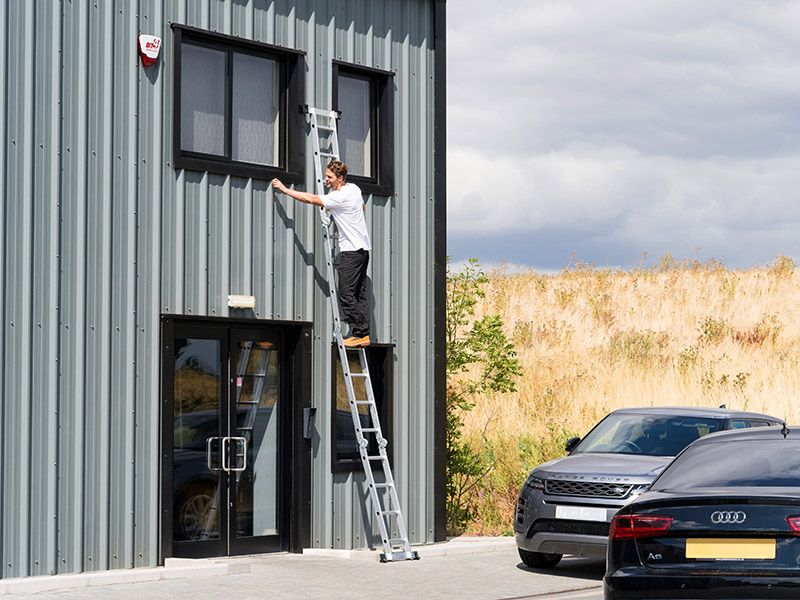
On extension ladders and combination ladders, the contact rule applies throughout the full climb. Both side rails and all rungs are available as grip points, making it easier to maintain three points of contact consistently.
Additional safe use rules for extension ladders:
Secure the top and bottom of the ladder before climbing
Set the correct angle: one unit out for every four units up
Keep your belt buckle within the width of the side rails. If you need to reach beyond it, descend and reposition the ladder instead
Preventing Falls: Common Mistakes That Break the Contact Rule
Carrying Tools or Materials in Your Hands
This is the most frequent breach of the three points of contact rule. Even a single item in one hand reduces you to two points of contact. Use a tool belt for small equipment and arrange for materials to be raised separately.
Reaching Beyond the Belt Buckle
Reaching to either side beyond your belt buckle shifts your centre of gravity outside the ladder's footprint. Descend, move the ladder, and climb again. It takes less time than recovering from a fall.
Standing on the Top Two Steps
The top two steps of a stepladder are not designed as a standing position. Standing on them removes any ability to grip a handhold at or above waist height, leaving you with no way to recover if balance is lost.
Fall Protection and the Work at Height Regulations 2005
The 3 point contact ladder rule sits within a broader legal framework. The Work at Height Regulations 2005 require employers to avoid work at height wherever reasonably practicable, and to use equipment that minimises the risk of falls where it cannot be avoided.
Ladders are a legitimate means of access under these regulations when a risk assessment confirms that equipment offering greater fall protection isn't justified due to the low risk and short duration of the task.
For longer tasks or where both hands must be free continuously, safety steps with integrated handrails are the appropriate solution.
Maintaining three points of contact is the behaviour. Choosing the right access equipment in the first place is how you keep workers safe and make that behaviour easier to sustain throughout the working day.
Frequently Asked Questions
What are the 3 points of contact on a ladder?
The three points of contact are any three of your four limbs in contact with the ladder simultaneously: two hands and one foot, or two feet and one hand. At least one hand must grip a rung or side rail at all times while climbing or descending.
What do you do when you need both hands free on a ladder?
If both hands are needed briefly, use your knees or chest against the ladder to maintain a third point of contact. If the task requires both hands to be free for a sustained period, use mobile safety steps or a guardrailed platform instead of a ladder.
Does the 3 point contact rule apply to stepladders?
Yes. The three points of contact rule applies to all ladder types, including stepladders. On a stepladder, two feet and one hand is the standard climbing position.
Posted in Health and Safety