

Falls from height remain the leading cause of fatal workplace injuries in Great Britain. According to the HSE fatal injuries report for 2024/25, 35 workers were killed as a result of falls from height in a single year, and the right ladders may have prevented these incidents.
This guide is written for facilities managers, warehouse teams, and health and safety officers who need a straight answer: when do you reach for a stepladder, and when do you need a leaning ladder?
You'll get a clear comparison of both types, a practical selection checklist, and the one factor most guides never mention, which often turns out to be the most important of all.
Step Ladder vs Ladder: Quick Overview
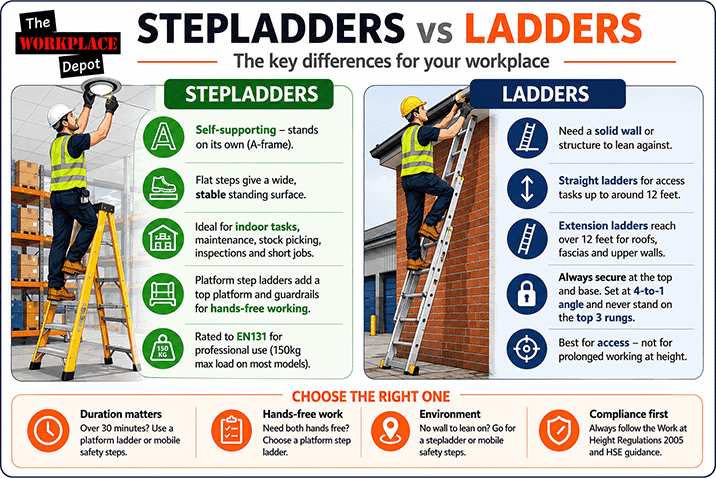
The core difference is support. A stepladder is self-supporting: it stands on its own as an A-frame and doesn't need a wall, surface, or structure to lean against. A straight ladder or extension ladder must be leaned against a solid surface to be used safely.
That single distinction shapes everything else: where each type can be used, how safely it can be set up, and whether it's the right choice for your task.
Before specifying either type, your starting point must be a risk assessment under the Work at Height Regulations 2005. The Regulations require employers to avoid work at height wherever reasonably practicable, and to use the equipment that best controls the risk when it can't be avoided. Choosing between ladders and stepladders sits firmly within that duty.
Step Ladder: Types, Uses and When To Choose

Stepladders come in two main types for workplace use: swingback stepladders and platform step ladders.
A swingback stepladder is the standard A-frame design. It's freestanding, portable, and easy to reposition, making it well suited to short-duration tasks that require you to move around frequently, such as changing a ceiling light fitting, accessing storage at height, or carrying out a quick inspection. Stepladders have flat steps rather than narrow rungs, which gives you a more stable standing surface. Most professional-grade models carry a maximum load of 150kg and are rated for commercial use under EN131.
A platform step ladder adds a standing platform at the top, giving you a defined working area rather than just a step. If you're regularly repositioning stock on racking, carrying out maintenance tasks, or doing any work that involves being at height for longer periods, a platform step ladder is the more practical and safer choice.
Browse our full stepladders range to find the right height and specification for your site.
Platform Step Ladder and Platform Ladders: Benefits
The advantage of a platform ladder over a standard swingback stepladder is stability at the working position. The top platform gives you a firm, level surface to stand on rather than balancing on a single step.
Key benefits of a platform step ladder for workplace use:
Hands-free working: Handrails and guardrails around the platform mean you can work without relying on the three points of contact rule. For electrical installations, shelf stacking, or painting overhead, that makes a significant practical difference.
Reduced fatigue: A defined standing surface is considerably more comfortable than a standard step for any task lasting more than a few minutes.
Extended task suitability: HSE guidance on safe use of ladders and stepladders recommends considering alternative equipment for tasks requiring more than 30 minutes of continuous use. A platform ladder bridges the gap between a standard stepladder and full mobile safety steps.
Greater stability: No balancing on a single rung. You have a defined, level working area throughout the task.
Straight Ladder and Extension Ladder: When They're Appropriate
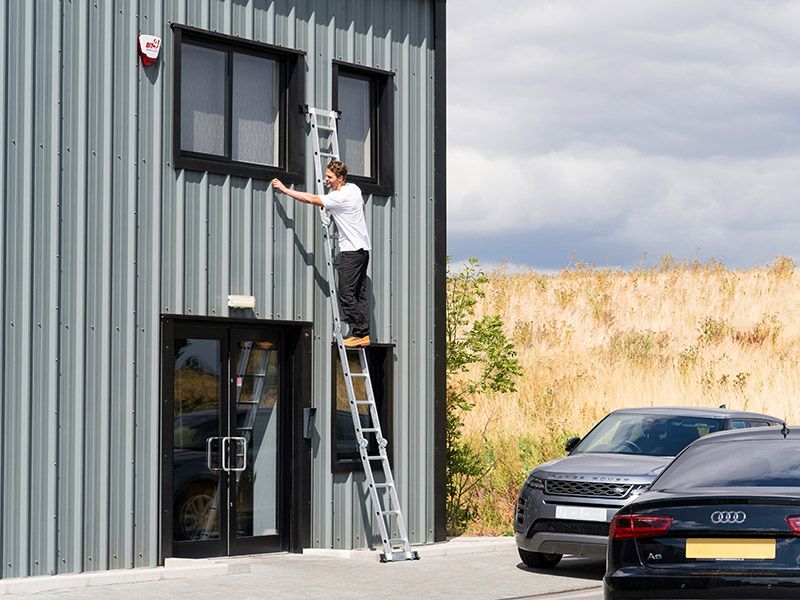
A straight ladder is a single-section leaning ladder. It requires a firm, stable surface to lean against and must be secured at the top and footed at the base before use. Extension ladders operate on the same principle, with two or three sections that slide and lock to achieve the working height you need.
When leaning ladders are the right choice:
Straight ladders and roof ladders: Getting up to a roof, reaching a high facade, or accessing a loft hatch at heights up to around 12 feet
Extension ladders: Rooftops, external walls, and upper facades where a freestanding ladder can't reach
Both types: Access tasks only — not suitable as a working platform and should never be used as a substitute for one
Safe use rules for all leaning ladders:
Tie off at the top or have a second person footing the ladder at all times
Never leave a leaning ladder unsecured
Confirm the surface you're leaning against is solid, stable, and won't shift under load
Extension Ladder: Reach Greater Heights
Extension ladders allow you to reach greater heights than any fixed-length stepladder can offer, making them the correct access equipment for external inspections, gutter work, and roof access in commercial and industrial settings.
The safe working rules for extension ladders are non-negotiable. Set the angle at 1 unit out for every 4 units up (the 4-to-1 rule). Never stand on the top three rungs: you need a handhold above your standing position at all times. Before every climb, check the push-up hooks, extension hooks, and locking mechanisms to confirm they're engaged and free from damage. A locking failure at height is not recoverable.
Extension ladders only work safely where there is a solid surface to lean against. If that surface isn't available, an extension ladder isn't the right tool regardless of the height you need to reach.
Mobile Solutions: Mobile Safety Steps and Telescopic Ladder
For workplaces where access requirements change frequently (warehouses, distribution centres, manufacturing facilities), mobile solutions offer the flexibility that fixed-position access equipment can't.
Mobile safety steps are freestanding, wheeled units that you can move and position without effort. They're the preferred access equipment for warehouse picking and racking tasks, giving you a safe standing platform that you can reposition down an aisle in seconds. For repeated access at the same working height throughout a shift, mobile safety steps are a more practical and safer choice than moving and re-footing a stepladder repeatedly.
A telescopic ladder is a variation of the leaning ladder that compresses down to a fraction of its extended length, making it easy to transport and store in a van or site vehicle. Before every use, check each locking mechanism individually as you extend each section. A partially locked section under load will fail.
If your team works across multiple access scenarios in a single day, a multi-purpose combi ladder is worth considering. It converts between extension ladder, stair ladder, scaffold, and workstation configurations in a single aluminium unit — covering most workplace access requirements without carrying multiple ladders on site.
Ladders and Stepladders: Selection Checklist For Your Workplace
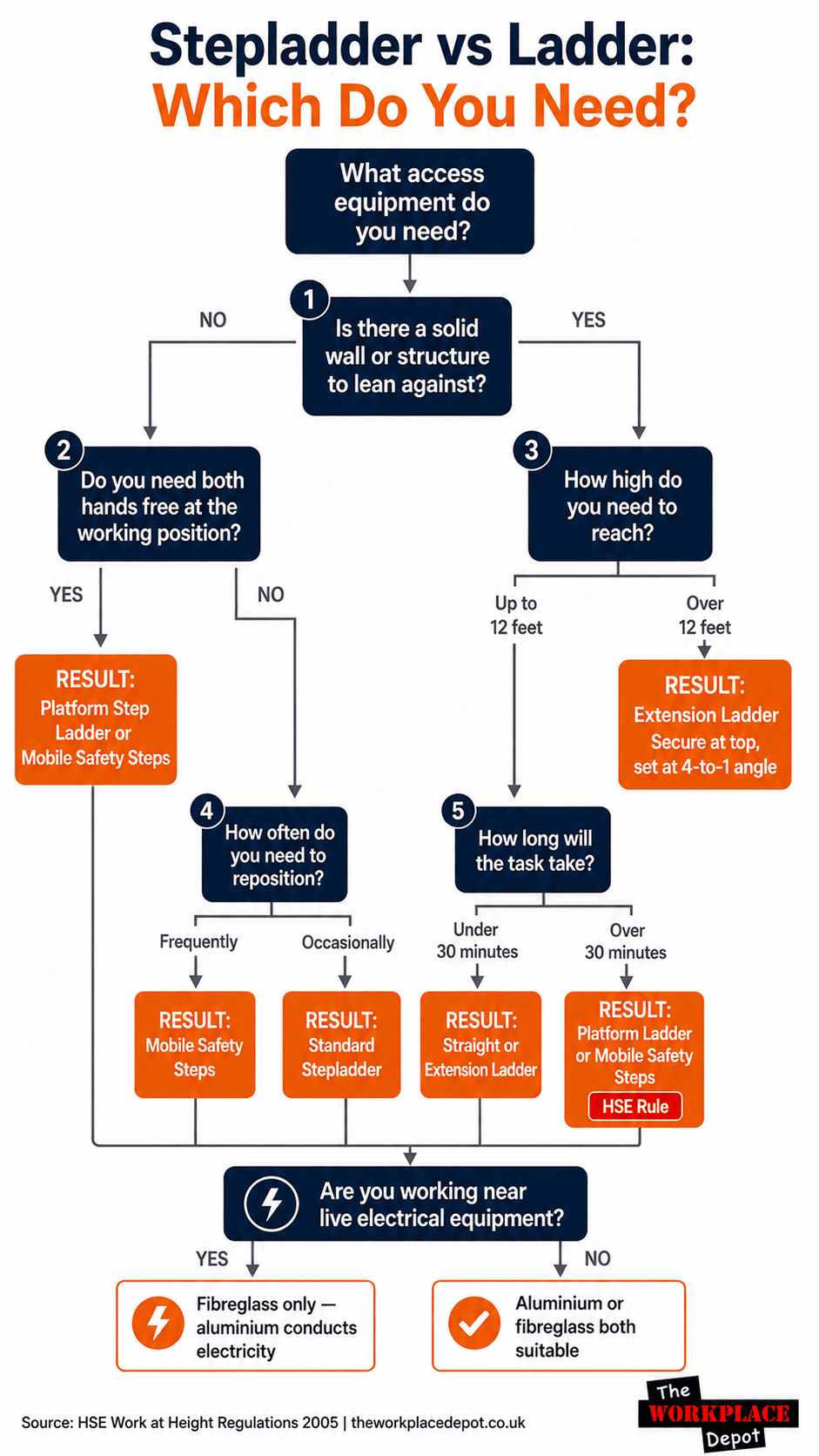
Use this checklist before specifying any access equipment for a new task or worksite:
Task duration: Will you be at height for more than 30 minutes continuously? If yes, a ladder or stepladder is not the right equipment. Consider a platform ladder, mobile safety steps, or a work platform instead.
Two-handed work: Does the task require both hands free at the working position, or will you be carrying heavy tools up with you? If yes, you need a platform with guardrails, not a standard stepladder.
Working height: What's the maximum height you need to reach? Stepladders typically cover tasks up to around 12 feet. For greater heights, extension ladders or mobile elevated platforms are appropriate.
Load capacity: Confirm the ladder's rated load includes your weight plus tools and materials. For professional workplace use, 150kg is the standard commercial rating.
Material: Working near live electrical panels or circuits? Specify a fibreglass step ladder: fibreglass is non-conductive. Aluminium is lighter and easier to transport but conducts electricity.
Storage and transport: Can the ladder be stored safely on site? Does it need to fit in a vehicle? Telescopic ladders and folding ladders offer the best portability for mobile teams.
Compliance: Confirm the ladder carries EN131 certification for professional use and follow HSE guidance on ladder selection.
Safe Use: Pre-Use Checks, Training and Regulations
Every ladder and stepladder should go through a pre-use check before it leaves the store:
Stiles and steps: no cracks, bends, or corrosion
Feet and rubber end-caps: intact and not worn smooth
Locking mechanisms and swing hooks: fully engaged with no play
Rungs and flat steps: free from mud, oil, or wet paint
Labels and ratings: legible and showing the correct load rating
Under the Work at Height Regulations 2005, employers are responsible for ensuring that anyone working at height is competent to do so. For ladder use, that means documented training records and evidence that operators understand safe use, not just a verbal briefing. Use a ladder safety tag kit to record inspection dates and flag equipment that requires withdrawal from service.
For unstable ground, awkward access points, or tasks where the ladder cannot be tied off, use a spotter to foot the ladder and provide a secondary safety check throughout the task.
Practical Workplace Scenarios: Which To Use
Warehouse picking and racking access: Mobile safety steps. They move freely, provide a safe standing platform, and can be repositioned without dismantling. A stepladder is slower and creates more opportunities for unsafe shortcuts.
Two-handed electrical installation work: Platform step ladder with guardrails. You need both hands free and a stable surface. A standard swingback stepladder doesn't give you either reliably.
External roof inspection or gutter clearance: Extension ladder, secured at the top, set at the 4-to-1 angle, with a second person footing. No alternative provides the reach safely without groundworks.
Work near live electrical panels: Fibreglass stepladder only. Never use an aluminium ladder within reach of live electrical equipment.
Narrow warehouse aisles: Narrow aisle safety steps or an order picking step trolley, designed specifically for access in tight spaces where a standard stepladder won't fit.
Maintenance, Storage and Inspection
Regular inspection isn't optional under the Work at Height Regulations 2005: it's an employer duty. Schedule formal inspections at regular intervals and log the findings. Any ladder showing cracks, bent stiles, worn feet, or locking faults should be quarantined immediately and removed from service.
Store ladders upright or horizontally in a dry, ventilated area, off the ground. Leaning stored ladders against a wall for extended periods can cause them to warp. Clean and lubricate locking mechanisms and swing hooks as part of planned maintenance, particularly on equipment used outdoors or in dusty environments.
Frequently Asked Questions
When should I use a stepladder instead of a leaning ladder?
Use a stepladder when there is no suitable surface to lean against, or when you need to work in the middle of a room or open space. Stepladders are self-supporting and don't require a wall. Use a leaning ladder when you need access to roofs, upper facades, or high external walls where a freestanding ladder can't reach safely.
What are my legal duties under the Work at Height Regulations 2005?
Employers must avoid work at height wherever reasonably practicable, and where it can't be avoided, use equipment that minimises the risk of falling. Ladders and stepladders are acceptable where a risk assessment confirms that higher fall protection isn't justified given the low risk and short duration of the task. Operators must be competent and trained.
What load rating should a workplace ladder carry?
For professional and commercial use, specify a ladder rated to a minimum of 150kg. This covers the operator's weight plus tools and materials carried. EN131 is the current standard for portable ladders and stepladders in the UK. Check the label before purchasing.
Can I use a standard aluminium ladder near electrical equipment?
No. Aluminium conducts electricity. Always specify a fibreglass ladder or fibreglass stepladder for any task near live electrical panels, circuits, or overhead cables. Fibreglass is non-conductive and is the correct material choice for electricians and facilities teams working near live equipment.
What is the 30-minute rule for ladders?
HSE guidance states that if a task requires you to remain on a ladder or stepladder for more than 30 minutes continuously, you should consider alternative equipment. Ladders are suitable for short-duration, low-risk tasks only. For longer tasks, a platform ladder, mobile safety steps, or a guardrailed work platform is the appropriate choice.
Choose the Right Access Equipment
There's no single perfect ladder for every workplace, and the right choice depends on more than just the height of your task. It depends on whether you have a surface to lean against, how long you'll be working at height, whether both hands need to be free, and what the task involves.
Our safety steps and ladders range covers stepladders, platform step ladders, mobile safety steps, telescopic ladders, warehouse ladders, and narrow aisle access equipment for every workplace environment. Free next-day delivery is available on all orders placed before 3pm. For bulk orders or technical specification support, contact our team directly.
Posted in Health and Safety