

Most people checking the safe working load on a piece of lifting equipment are looking for one number. But that number was calculated for specific conditions: a straight pull, normal temperature, no shock loading, ideal configuration. Change any of those conditions and you've changed the effective SWL, whether the label has been updated or not.
That gap between the marked figure and the real-world capacity is where lifting equipment fails, loads drop, and LOLER breaches happen. The Workplace Depot has been supplying lifting and material handling equipment to UK businesses for over 30 years, and the pattern is consistent: the label gets checked, the operating conditions don't.
This guide covers what safe working load means, how it's calculated, the difference between SWL and WLL, and the factors that quietly reduce your effective SWL in real working conditions.
What Is Safe Working Load? SWL Meaning Explained
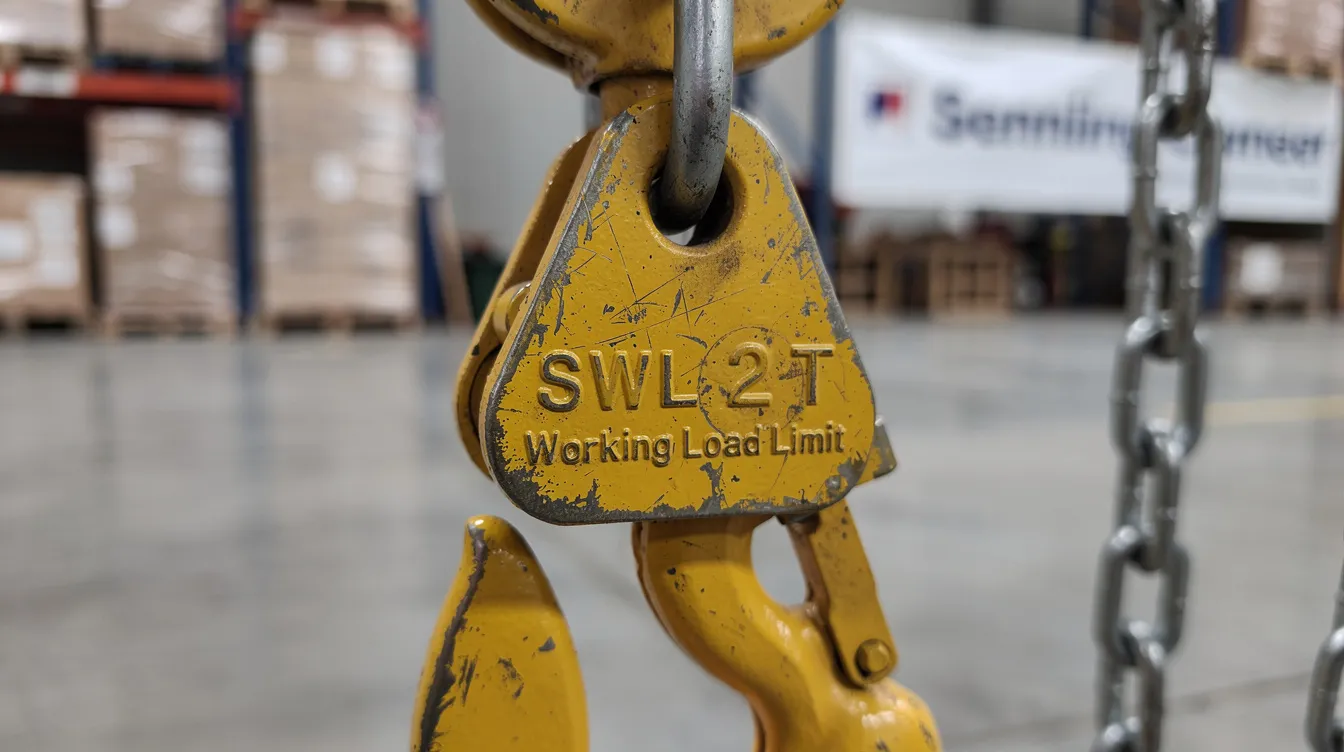
What Does SWL Stand For?
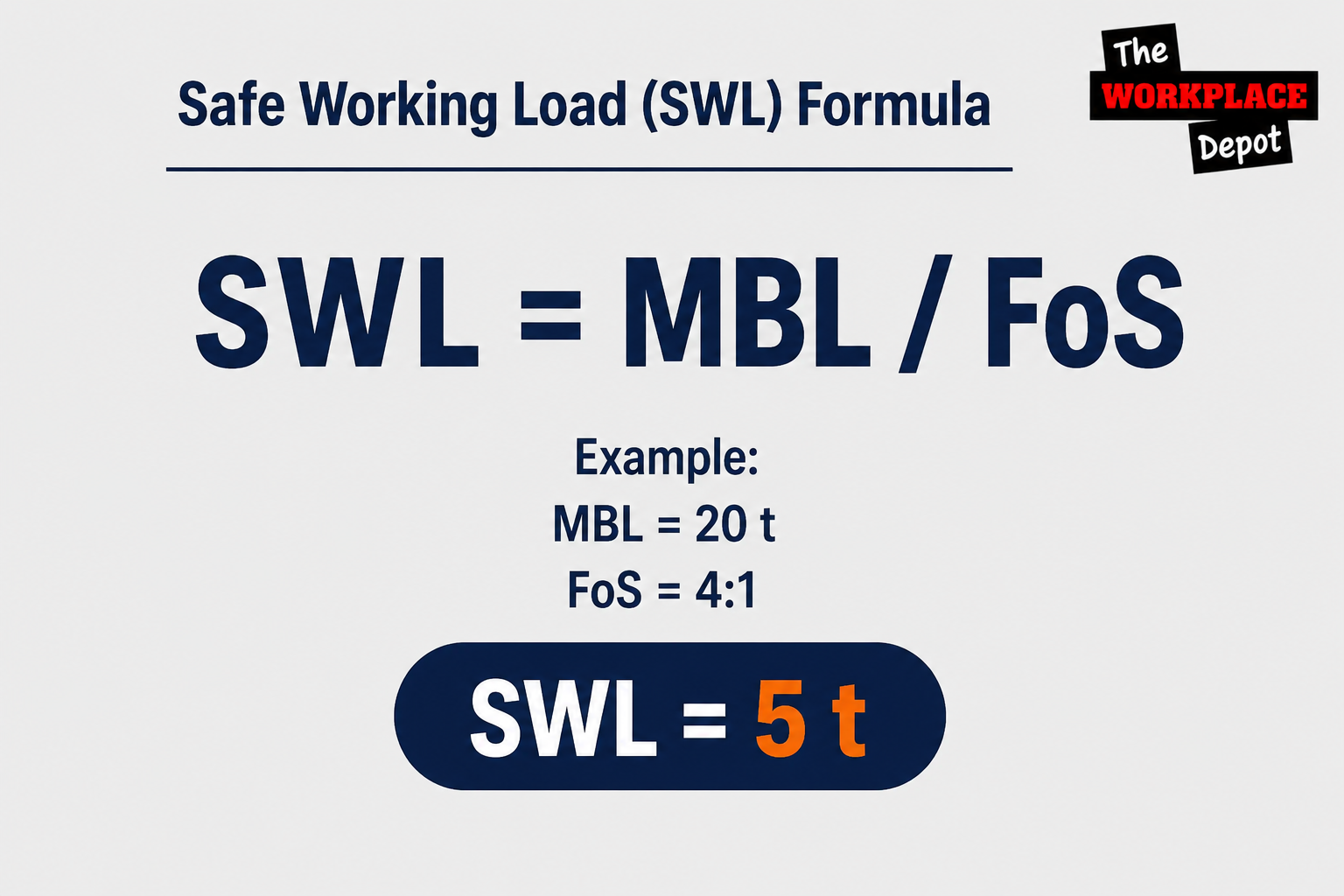
SWL stands for Safe Working Load. It is the maximum load that a piece of lifting equipment can safely handle under specified conditions. It's calculated by dividing the equipment's Minimum Breaking Load (MBL) by a Safety Factor (FoS):
SWL = MBL / FoS
The Minimum Breaking Load is the force at which equipment is expected to fail under testing. It's not a working figure; it's the destruction threshold.
The Safety Factor is the buffer between that threshold and the load you're actually permitted to apply. For most lifting equipment under LOLER 1998, the safety factor ranges from 4:1 to 7:1, meaning the equipment must be able to withstand four to seven times its SWL before failure.
So a chain with an MBL of 20 tonnes and a 4:1 safety factor has a safe working load of 5 tonnes. In a straight pull, under normal conditions.
That last part matters more than most people realise.
SWL, Normal Working Load and What the Limit Actually Means
In practice, the safe working load defines the upper load boundary for safe lifting operations, not a typical working figure. It's the absolute limit under normal working conditions, and exceeding it removes the safety margin that protects against dynamic loading, material fatigue, and environmental variation.
LOLER 1998 requires that all lifting equipment is clearly marked to indicate its SWL or WLL where that information is necessary for safe use.
Critically, where the SWL of any equipment depends on its configuration, the marking must reflect all configurations in which the equipment may be used. Not just the most favourable one.
How to Calculate a Safe Working Load
The Formula
The basic safe working load calculation is straightforward:
SWL = MBL / Safety Factor
Where MBL is the Minimum Breaking Load (or Minimum Breaking Strength) of the component, and the Safety Factor is determined by the application and the applicable standard.
Example: a wire rope sling with an MBL of 30 tonnes used with a 5:1 safety factor has a WLL of 6 tonnes in a straight pull. That's the baseline.
Load Factor, DAF and the Minimum Safety Margin
SWL can also be expressed as:
SWL = WLL / DAF
Where DAF is the Dynamic Amplification Factor: a multiplier that accounts for the forces introduced by acceleration, deceleration, and movement during lifting operations.
A load being raised smoothly applies less force than the same load being jerked upward or shock-loaded.
Dynamic loading can multiply the effective force the equipment experiences well beyond the static weight of the load. This is why operating at the maximum rated capacity is genuinely risky even when the load weight appears to be within limits: a sudden movement or jerk can push the effective force past the SWL without the operator realising it.
Safe Working Load vs Working Load Limit: What's the Difference?
The Terminology Shift
WLL (Working Load Limit) has largely replaced SWL as the preferred term since the mid-2000s, driven by international standardisation including BS EN 13155.
According to guidance on how WLL and SWL differ, WLL is fixed and traceable: it's certified by the manufacturer against a defined safety factor and tied directly to tested material properties. It cannot be adjusted in the field.
SWL was historically more flexible. A competent person could reduce it based on operational conditions, which introduced inconsistencies between sites and operators.
WLL removed that ambiguity by anchoring the figure to the manufacturer's certification.
Both terms remain acceptable under LOLER. You'll see SWL on older equipment and WLL on newer. The regulatory requirement is the same: the figure must be marked, legible, and appropriate for every configuration the equipment is used in.
Which Applies to Your Equipment?
The practical distinction is this: WLL is the manufacturer's certified maximum and is fixed. SWL is the maximum appropriate for your specific operation, which may be lower than the marked WLL once you account for configuration, environment, and application.
This is where most organisations have a blind spot. They check the WLL marked on the equipment and treat it as the answer. In many situations, it's only the starting point.
Why the SWL on Your Equipment Is Only Half the Story
This is the part most skip. The safe working load marked on your equipment was calculated for a specific set of conditions. Every time those conditions change, the effective SWL changes too.
How Sling Angle Reduces SWL
Take a two-leg chain sling with a rated capacity of 10 tonnes (5 tonnes per leg in a straight pull). At first glance, a two-leg configuration should be able to lift 10 tonnes. But the moment you introduce an angle, the forces in each leg increase significantly.
The formula for a two-leg sling is:
WLL (assembly) = 2 x single leg WLL x cos β
Where β is the angle of each leg from vertical.
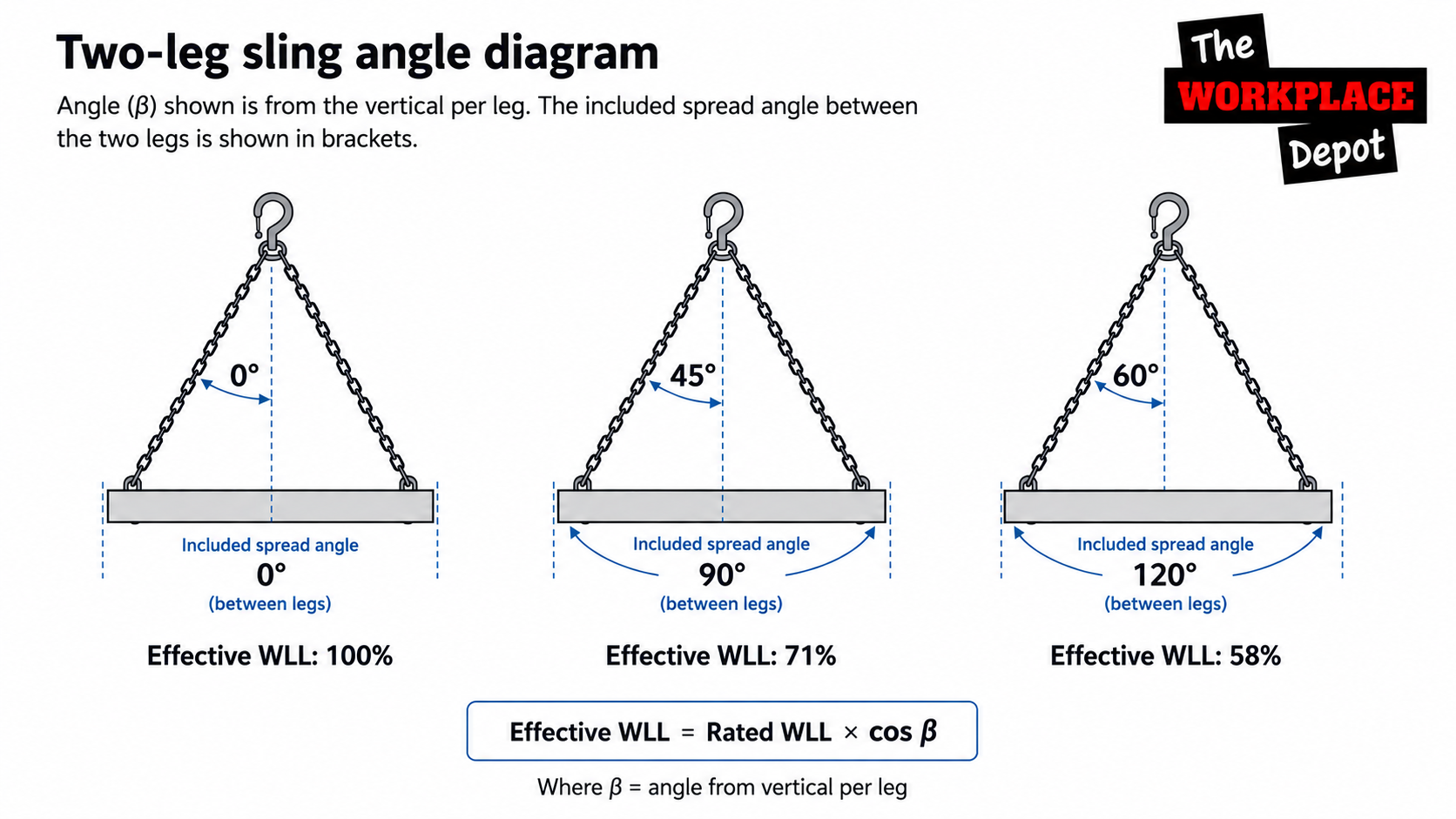
At 0 degrees (perfectly vertical), cos β = 1.0, so the full rated capacity applies. At 45 degrees, cos β = 0.707. Each leg carries 1.41 times the load weight. The assembly's effective WLL drops to approximately 7.07 tonnes. At 60 degrees, cos β = 0.5. Each leg carries 2.0 times the load weight. The assembly's effective WLL drops to 5 tonnes.
No chain sling should be used at more than 60 degrees from vertical. Beyond that point, the force in each leg increases to the point where equipment failure becomes probable even within the nominal load limit.
The same principle applies to spreader beams, wire rope slings, and any multi-leg lifting configuration. The angle is not a minor consideration. It is part of the SWL calculation.
How Environmental and Operational Factors Change SWL
Configuration is one variable. There are others.
Elevated temperatures reduce the tensile strength of steel components, which reduces the effective SWL of chains, hooks, and slings. Chemical exposure can degrade material properties.
Wear and fatigue from repeated loading accumulate over time, meaning a component that passes visual inspection may have a reduced effective capacity compared to its original rated figure.
Shock loading is the most dangerous.
Any sudden application of force, a load that swings, catches, or drops suddenly, creates a dynamic spike in effective load far exceeding the static weight. This is why the DAF matters in practice and why it's not safe to assume that a load weighing 4 tonnes can be moved on equipment rated to exactly 4 tonnes.
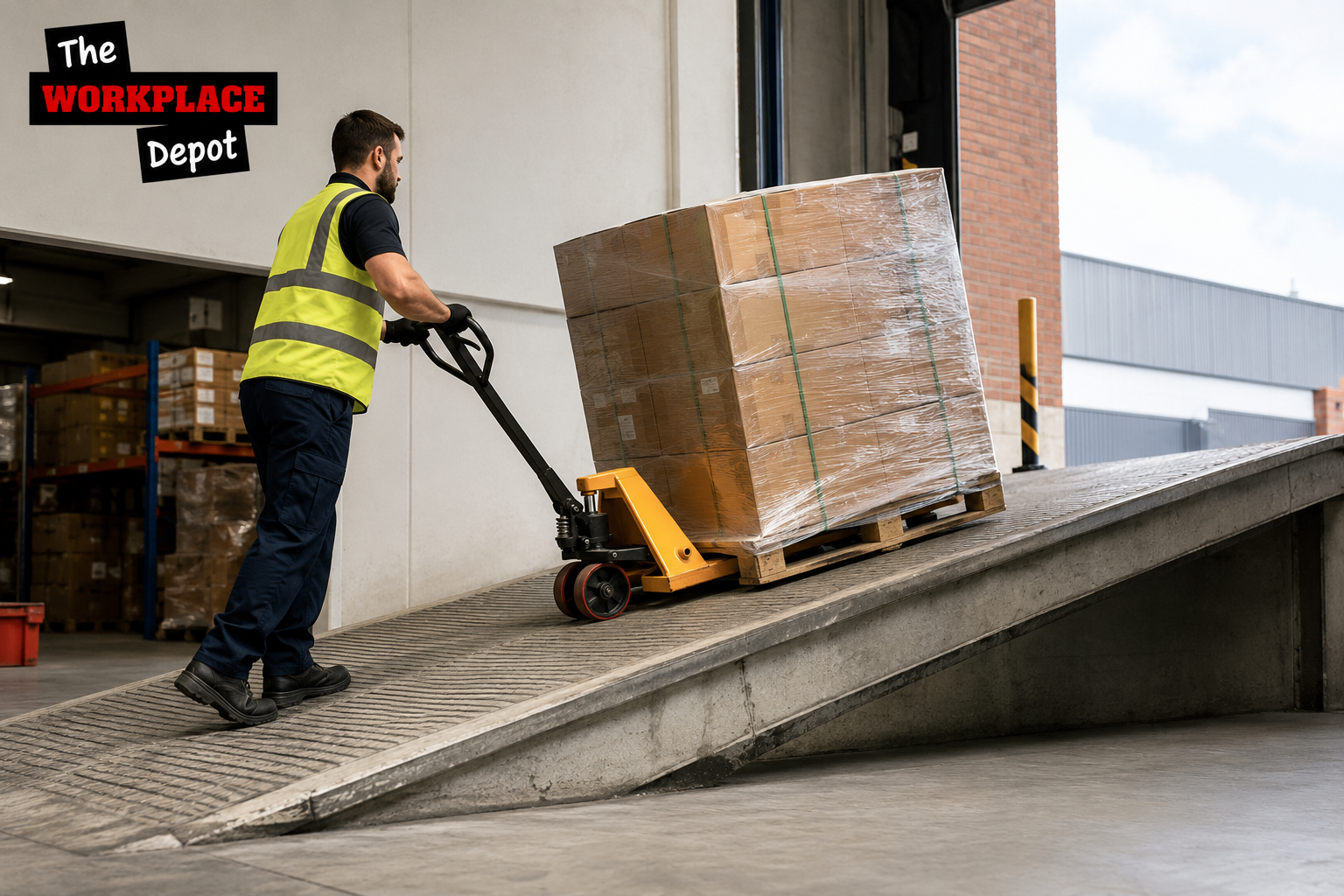
Surface conditions matter too. A pallet truck rated at 2,500kg on a flat floor does not have the same effective safe working load on a gradient.
As the angle of incline increases, the effective load increases and braking capacity reduces. The manufacturer's rated capacity applies to level surfaces.
Operating on a ramp at rated capacity is operating outside the conditions for which the SWL was calculated.
How Configuration Changes SWL Across Equipment Types
LOLER is explicit on this point: where the SWL of lifting equipment depends on its configuration, the marking must reflect all configurations. A spreader beam used in different ways has a different SWL for each setup. A gantry crane operating at different radii has different rated capacities at each position. Hoists operating at different angles to the load have varying effective capacities.
The competent person carrying out the risk assessment must identify all configurations the equipment will actually be used in during lifting operations, not just the simplest one. If the marking on the equipment only reflects one configuration, it's not LOLER-compliant.
For equipment The Workplace Depot supplies, including high lift pallet trucks with capacities up to 1,500kg, the rated capacity reflects normal operating conditions on level ground.
Environmental factors, gradients, and operational conditions all feed into the effective safe working load for your specific application.
LOLER, SWL Compliance and Your Legal Duties
What LOLER Requires
Under LOLER 1998, the core obligations for lifting equipment are: that it is strong and stable enough for its intended use, clearly marked with its SWL or WLL, thoroughly examined by a competent person at defined intervals, and that records of those examinations are maintained.
For lifting accessories such as chain slings, hooks, and shackles: thorough examination every 6 months. For other lifting equipment: every 12 months, or at intervals specified in an examination scheme drawn up by a competent person.
If the SWL marking on any piece of lifting equipment is missing, damaged, or illegible, it must be removed from use until the marking is restored and verified.
Safe Practices When Working with Load Limits
Never Treat SWL as a Target
SWL is a ceiling, not a working figure.
Operating consistently at or near the maximum load accelerates wear, increases fatigue in components, and reduces the safety margin that protects against unexpected dynamic forces. Safe lifting practice maintains a practical working margin below the SWL, particularly for dynamic lifting operations where DAF applies.
If a load is close to the rated capacity of the equipment, that's the point to stop and reassess: use equipment with a higher rated capacity, reconfigure the lift, or reduce the load. Don't proceed and rely on the safety factor to absorb the excess.
Inspection, Marking and Records
Any piece of lifting equipment that has been overloaded, even if it appears undamaged, should be inspected by a competent person before being returned to service. Irreparable damage from overloading is often not visible to the naked eye. Anyone that has experienced a load spike beyond its SWL may have undergone internal deformation that compromises its future capacity.
Equipment that cannot be confirmed as safe following an overload incident should be replaced, not returned to use. The cost of replacement is not comparable to the cost of a dropped load.
For The Workplace Depot's electric pallet trucks and other material handling equipment, always operate within the rated capacity, follow the manufacturer's instructions for permitted surfaces and gradients, and ensure any operator carrying out lifting operations understands the effective SWL for their specific application and environment.
Frequently Asked Questions
What does SWL stand for?
SWL stands for Safe Working Load: the maximum load that a piece of lifting equipment can safely handle under specified conditions. It is calculated by dividing the equipment's Minimum Breaking Load by a Safety Factor, typically 4:1 to 7:1 for lifting equipment under LOLER.
What is the difference between SWL and WLL?
Working Load Limit (WLL) is the modern, preferred term. It is fixed by the manufacturer and certified against a defined safety factor. SWL is an older term that was historically more flexible and could be adjusted in the field. Both are acceptable under LOLER, but WLL is now the standard term in most lifting equipment specifications. In practice, the SWL for your specific operation may be lower than the marked WLL once configuration, angle, and environmental factors are accounted for.
How is safe working load calculated?
SWL = Minimum Breaking Load divided by Safety Factor. For a chain with an MBL of 20 tonnes and a 4:1 safety factor, the SWL is 5 tonnes in a straight pull. In dynamic lifting operations, the effective safe capacity is further reduced by the Dynamic Amplification Factor (DAF), which accounts for the forces introduced by acceleration and movement.
Does safe working load change with sling angle or configuration?
Yes. A two-leg chain sling at 60 degrees from vertical has a significantly lower effective capacity than the same sling in a straight pull: WLL (assembly) = 2 x single leg WLL x cos β. At 45 degrees, the effective assembly WLL is approximately 70% of the straight-pull figure. At 60 degrees it drops to 50%. No sling should be used beyond 60 degrees from vertical. LOLER requires that all configurations in which equipment is used are reflected in its SWL markings.
What are the LOLER requirements for SWL marking in the UK?
Under LOLER 1998, all lifting equipment must be clearly marked with its SWL or WLL where that information is necessary for safe use. Where the SWL varies by configuration, all configurations must be shown. Equipment must be thoroughly examined by a competent person at intervals defined by LOLER: every 6 months for lifting accessories, every 12 months for other lifting equipment.
What happens if you exceed the safe working load?
Exceeding the SWL removes the safety margin that protects against dynamic forces, fatigue, and environmental factors. It risks equipment failure, dropped loads, and serious injury. Under LOLER, it also constitutes a regulatory breach. Any equipment that has been overloaded must be inspected by a competent person before returning to service and replaced if its safe condition cannot be confirmed.
Posted in Health and Safety